Thursday, March 28, 2019

The Stock Market Surges Again, But Why?

&l;p&g;&l;img class=&q;size-full wp-image-565&q; src=&q;http://blogs-images.forbes.com/bradmcmillan/files/2019/03/StockMarket_Forbes_640px.jpg?width=960&q; alt=&q;The Stock Market Surges Again&a;mdash;But Why?&q; data-height=&q;426&q; data-width=&q;640&q;&g; The Stock Market Surges Again&a;mdash;But Why?

After a decline at the close of 2018, the stock market is once again getting close to new highs. But this surge is a bit puzzling given that earnings expectations have pulled back. Of course, earnings had a strong 2018, driven by the tax cuts and faster economic growth. Now, however, earnings growth is expected to revert to lower levels as the tax cut effects normalize and growth slows around the world. With earnings growing slower, stocks should pull back&a;mdash;but they&a;rsquo;re not. What&a;rsquo;s going on?

&l;strong&g;The usual suspects&l;/strong&g;

I suspect the bounce is coming from two main factors. First, against expectations, slower growth has been good for the market. Interest rates have actually gone down, which drives stock valuations up. Second, even as growth has slowed, confidence has rebounded with the end of the government shutdown and on continued strong job growth&a;mdash;and that has also pulled valuations back up.

&l;strong&g;Interest rates. &l;/strong&g;When rates rise, valuations drop; when rates drop back, valuations tend to tick up&a;mdash;which is just what we have seen recently. Rates were rising last year on the faster growth of 2018, which was a headwind to the market, but the recent drop has helped. In that sense, slower growth has moved the economy back into the sweet spot of slower but sustainable growth that the market likes, which has led to the recent bounce. Growth is expected to be slower this year, both here and abroad, which suggests the rising stock market may continue for a while.

&l;strong&g;Consumer confidence. &l;/strong&g;There is a similar relationship&a;mdash;but even stronger&a;mdash;between consumer confidence and stock valuations. Confidence remains extremely high but pulled back sharply at the end of last year before bouncing, just like the stock market. Confidence is largely driven by the jobs market. So here, too, the data suggests the market could well keep rising as long as the job market remains solid.

&l;strong&g;When will the bull market end?&l;/strong&g;

With both of these factors positive and likely to remain so, the current gains may well be extended&a;mdash;potentially for some time.&a;nbsp;But we need to keep an eye on just how long that might be. We can do&a;nbsp;so in two ways. The first is to watch the two metrics in question, interest rates and consumer confidence. Those are indeed the key indicators that are likely to determine when the current bull market finally ends. Right now, the news is good.&a;nbsp;That doesn&a;rsquo;t mean that the tree will grow to the sky, however. At some point, economic gravity will reassert itself. The question is, when?

In the past six years or so, valuations have generally ranged between 14x and 18x forward earnings. The recent dip took us down to the lower end of that range, and we are now at about the middle (i.e., about the recent normal). Looked at this way, the recent pullback and bounce were just noise, and we are now about where we&a;nbsp;should expect to be.

This level puts a constraint, however, on likely future appreciation. Absent earnings growth, if the market rose another 10 percent to 15 percent, we would be at the upper end of the recent historic range, which is probably a reasonable limit. At that point, it would again become dependent on faster earnings growth.

To answer the question we started with, the recent market pullback and recovery just took us on a round trip within the recent valuation range. As such, current values are likely sustainable, at least for a while. More, we do have some room to the upside (but not all that much). The party may well continue.

&l;strong&g;The real risk&l;/strong&g;

We do need to keep watch, however, on earnings for the future and, even more important, on confidence and rates. The real risk is whether valuations shift again, and that will be the best warning sign to watch.

&l;/p&g;

Monday, March 25, 2019

Zimmer Biomet Holdings: Management Expects Modest Growth

Introduction

Zimmer Biomet Holdings, Inc. (NYSE:ZBH) provides medical knee and hip replacement products, sports medicine, trauma products, spine products, face and skull reconstruction products, medical devices and surgical instruments, and dental products.

Zimmer Biomet has a history of subdued growth and its earnings have been volatile since the company acquired Biomet. The company is introducing new products having just received FDA clearance for a new knee system using robotics. Also Zimmer Biomet has partnered with Apple (NASDAQ:AAPL) with a new app for knee and hip replacement patients.

The company's management feels comfortable that they can generate modest earnings growth for 2020 and beyond. Over the long term the stock price could trade up but I think this would only be achieved if the company succeeds in generating its earnings growth.

The stock price is not overly expensive with a forward PE multiple of 15.6x and at book value of 2.3x. Also the stock pays a modest 0.75% dividend.

Financials

Zimmer Biomet has reported financial results for the fourth quarter of 2018 (data from Seeking Alpha and Yahoo).

The company's reported forth quarter revenue was flat over the fourth quarter of 2017. Zimmer Biomet reported diluted earnings per share loss of $4.42 compared to a profit of $6.03 reported in the fourth quarter of 2017. The EBIT was down 3.1% over the fourth quarter of 2017.

On an annual basis, revenue for 2018 was up 1.7%. Zimmer Biomet reported a full year diluted earnings per share loss of $1.86 compared to a profit of $8.90 reported for the 2017 fiscal year. Zimmer Biomet 2018 EBIT was down 14% over the 2017 fiscal year.

Zimmer Biomet paid a dividend of $0.96 for the 2018 fiscal year which was the same dividend paid for the previous two fiscal years. The current trailing yield is 0.75% and the forward yield is 0.75%.

The return on equity is not applicable at present as Zimmer Biomet booked an earnings loss for both its quarterly and annual income. Over the last decade the best return on equity was 15% which was achieved in the 2017 fiscal year. For the years with lower profits the return on equity can be down to 3%.

The profit margin is also not currently applicable for the same reason. The best profit margin of 23% was also achieved in 2017. For the years with lower profits the profit margin was down to 3%.

Zimmer Biomet's current ratio is 1.8 meaning that its current assets exceed its current liabilities. Zimmer Biomet has a history of operating with a decent amount of working capital. The current ratio has ranged from 1.5 to 3.6 over the last decade.

The asset ratio (total liabilities to total assets) is 53% which means that Zimmer Biomet's total debt is 53% of the value of everything the company owns (note that the asset value is the book value and not the liquidated value of its assets). Over the last decade Zimmer Biomet's asset ratio has ranged from 35% to 64%.

The company's book value is currently $55.25 and with a stock price of $130 Zimmer Biomet is trading at 2.3x book value.

The analysts' consensus forecast is for revenue to increase by 0.3% in 2019 and increase 2.4% in 2020. Earnings are forecast to recover in 2019 from its 2018 and then increase 6.5% in 2020. The 2020 PE ratio is 15.6x.

The financials reveal that Zimmer Biomet's debt is under control and that the company can operate efficiently when booking a decent profit.

Revenue and Earnings

As an investor I personally like to examine the company's revenue and earnings history. To make this task easier and more convenient I like to visually present the data on a chart.

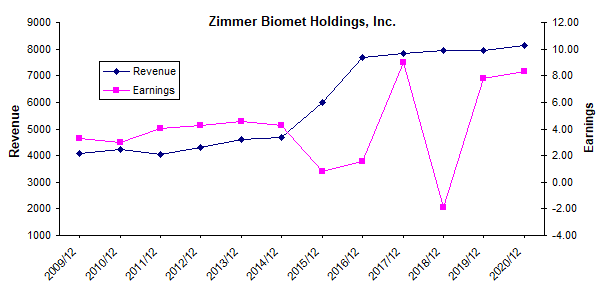
Zimmer Biomet revenue and earnings chart

Zimmer Biomet data by ADVFN

The above chart visually shows Zimmer Biomet's revenue and earnings historical trend along with the next two years of consensus forecasts.

Examining the chart reveals that most of Zimmer Biomet's revenue increases occurred over the 2015 and 2016 fiscal years.

This growth surge was the result of a significant acquisition. In 2015 the company acquired Biomet for $14 billion and changed its name from Zimmer Holdings to Zimmer Biomet Holdings. The revenue and earnings for the 2015 fiscal year partly included Biomet's results and from 2016 onwards includes Biomet's full year results.

The revenue growth from 2009 to 2014 was 2.7% per year (without Biomet) and from 2016 to 2018 revenue grew at a similar rate (with biomet). The forecasts show the mild growth from 2016 continuing into 2020.

The earnings were fairly stable prior to 2014 (without Biomet) with little growth and then became volatile (with Biomet) with a loss booked for 2018. The forecasts show Zimmer Biomet's earnings recovering in 2019 with a moderate increase for 2020.

While it's just an observation, it does appear to me that the company's earnings have become volatile since it acquired Biomet. This volatility may settle down in the future and the analysts have forecast more steady earnings growth heading into 2020.

The earnings losses for 2018 were largely due to a $975.9 million Goodwill Impairment recorded on its income statement. CFO Dan Florin stated in the company's earnings call:

We recorded a one-time non-cash charge of $4.78 per share related to goodwill impairment of our Spine and EMEA reporting segments.

On an adjusted basis earnings were a profit of $2.18 per share for the quarter compared to $6.03 from the fourth quarter of 2017. Even though it's a profit, it's still down from the previous corresponding quarter.

After the company's quality control and supply chain issues, Zimmer Biomet's new CEO, Bryan Hanson, who was appointed in December 2017, is looking to drive the company forwards. As he stated in the company's earnings call:

Once we stabilize the business and have begun to deliver 2% to 3% growth in 2020 we will be well-positioned to execute against a 5-year plan that will accelerate our revenue growth, drive margin expansion, and increase free cash flow.

There's no point in dwelling on the past. As investors, it's going forwards that matters. The revenue growth in the past has been subdued with volatile earnings.

The company is introducing new products. The company has just received FDA clearance for a new knee system using robotics and they will likely receive FDA clearance of Rosa Spine. Zimmer Biomet is continuing its endeavor into digital technology having partnered with Apple. The mymobility app is being trialed on knee and hip replacement patients for their care requirements after surgery.

In a society were obesity is increasing, the requirement for Knee and hip replacements will also increase, and this will directly benefit Zimmer Biomet. Also knee injuries become more common with people who enjoy active lifestyles, especially those who are sports-oriented. Given that the population is expanding, this will naturally increase the requirement for knee and hip replacements. There's also the aging population who tend to need these replacements.

I think the company will benefit in the long run and management seems focused on the task of improving its earnings growth. The product lineup from the company includes an array of medical products, including dental. While the younger population nowadays have healthy teeth, this is not the case with the older population where tooth decay is a major problem that cannot be reversed. This older population will require dental products (such as implants) well into the future. This will ensure that Zimmer Biomet's dental products will be in demand for many years to come.

Stock Valuation

Zimmer Biomet has a history of moderate revenue growth and a volatile earnings history since it acquired Biomet. The company could not be considered a growth stock, but if its future growth expected growth materializes then it could possibly be valued as a moderate growth stock using the PEG (PE divided by the earnings growth rate).

The company's CFO gave a 2% to 3% growth figure for 2020 in their earnings call. The analysts had a 6.5% growth rate.

The 2% growth is realistically too low to use for the PEG valuation (it gives a PEG of 8.3 which gives a fair value of only $16).

The analysts have a higher 6.5% growth but the problem with this is that there's no history to back up this growth rate (which means it's highly speculative)

Given that there's no appreciable historical growth, I think it's best not to use the PEG to value the stock. Zimmer Biomet's 2020 forward PE is 15.6x and its current book value is 2.3x. These metrics give me a feel for the stocks value based its $130 stock price. At this price I don't consider the stock expensive, but it's certainly not cheap.

Stock Price

As an active investor I personally like to determine some likely price targets. This gives me a feel for how high the stock price could go in the short term and how soon it could get there.

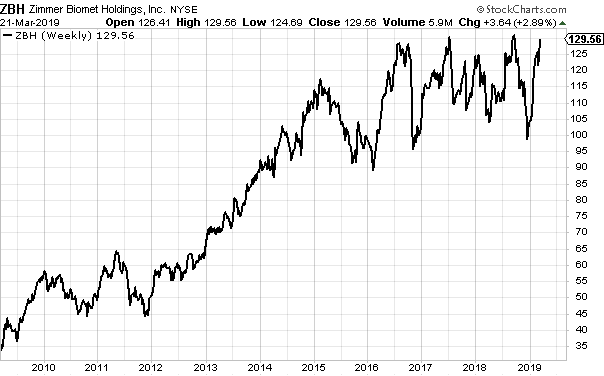
Zimmer Biomet ten year stock chart

Zimmer Biomet chart by StockCharts.com

The stock chart reveals that Zimmer Biomet's stock price broadly traded up and essentially traded sideways from 2016. Interestingly it has traded sideways since it acquired Biomet.

The new CEO has being working on improving the company's quality control and supply issues since the start of 2018, but the market didn't respond. I think the stock will likely remain in its trading range until it shows some decent earnings growth.

Over the long term the stock price could trade up, but I think it would only stay there if the company generates earnings growth.

Conclusion

Zimmer Biomet is a company with a history of subdued growth and a volatile earnings history since the Biomet acquisition. The company is introducing new products, having just received FDA clearance for a new knee system using robotics, and has partnered with Apple trialing a new app for knee and hip replacement patients.

Management feels comfortable that the company can generate modest earnings growth going forward. Over the long term the stock price could trade up but I think it would only stay there if the company succeeds in generating its earnings growth.

The stock price is not overly expensive with a forward PE multiple of 15.6x and at book value of 2.3x. Also the stock pays a modest 0.75% dividend.

Disclosure: I/we have no positions in any stocks mentioned, and no plans to initiate any positions within the next 72 hours. I wrote this article myself, and it expresses my own opinions. I am not receiving compensation for it (other than from Seeking Alpha). I have no business relationship with any company whose stock is mentioned in this article.

Saturday, March 23, 2019

Rally in midcaps at early stage of uptrend, 30% upside possible: ICICI Securities


ICICI Securities

The sharp rally over the past couple of weeks has taken many by surprise. Investors have been left wondering if the rally has further legs or whether this should be viewed as an exit opportunity, especially in the beaten down midcap and smallcap space?

We do not foresee midcap and smallcap indices to challenge February lows as the current rally is at the early stage of a major uptrend. We recommend investors to start accumulating quality midcap stocks to ride the next leg of a major up move (around 30 percent from hereon). We expect bouts of volatility to persist in the run-up to the general election 2019 that should be capitalised as an incremental buying opportunity.

We focus on examining the market internals of the ongoing rally in midcap and small-cap stocks, drawing inferences from prevailing time cycles to ascertain the future course for the rest of 2019. Our thesis is corroborated by following findings:

related news Why Dish TV, BPCL and Power Grid are a buy What to keep in mind when rebalancing your portfolio? 'Expect huge short covering in next 10 days, buy every decline'

• Since its inception in 2003, all three major corrections (2008, 2011 and 2015) in Nifty Midcap index, have matured in 14 months, followed by average minimum returns of 40 percent, in the following year. In the previous three instances, Nifty midcap index had rallied 169 percent, 41 percent and 48 percent on completion of the 14-month cycle. Although the Nifty Midcap index has already rallied 12 percent from February 2019 low (16,045), at least another 30 percent rally is ahead of us.

Image218032019

• Noteworthy simultaneous improvement in twin breadth indicators, confirm maturity of 14-month down cycle, similar to the past three instances
a) percentage of stocks above 200-DMA reversing above 50, after falling below 20

b) advance-decline summation index reversing to positive zone after recording extreme bearish set-up

Here are five midcap picks that could return more than 20%:

Image118032019

Ipca Laboratories | Target: Rs 1,080 | Stop loss: Rs 758

> Breakout from a five-year consolidation signals a structural turnaround
> A faster retracement as 14 quarters decline (Rs 906-400) is completely retraced in just six quarters

> We expect the stock to continue its current up move and test levels of Rs 1,090 as it is the 138.6 percent external retracement of the entire previous decline (Rs 907 to Rs 400)

Kansai Nerolac Paints | Target: Rs 550 | Stop loss: Rs 405

> At the cusp of a falling channel breakout containing entire decline since high of Dec'17 (Rs 614)
> A slower retracement as the stock has already taken 14 months to retrace just 80 percent of the previous 12 months' up move from Rs 319 to Rs 614

> The favourable risk-reward set-up offers a fresh entry opportunity for upside toward Rs 560 as it is 80 percent retracement of the entire decline (Rs 614 to Rs 343)

NBCC India | Target: Rs 80 | Stop loss: Rs 56

> Double bottom breakout aided stock to resolve out of long-term falling trendline to longest pullback since November 2017 along with a faster retracement as six weeks decline (Rs 63-47) has been completely retraced in four weeks

> We expect the stock to resolve higher towards August 2018 high Rs 80 as it is the 61.8 percent retracement of the last decline (Rs 109 to Rs 47)

Bank of India | Target: Rs 110 | Stop loss: Rs 83

> The stock has been forming a base at key support zone of Rs 80 as on multiple occasions it respected May 2005 lows (Rs 80)
> Monthly RSI recorded a bullish crossover after witnessing a positive divergence

> We expect the stock to continue its current up move and test Rs 110 as it the high of January 2019 and 80 percent retirement of the previous major decline (Rs 119 to Rs 73)

Lux Industries | Target: Rs 1,560 | Stop loss: Rs 1,152

> Breakout from a major falling channel contains the entire corrective decline
> The stock in March rebounded from the major support area of Rs 1,100 as it is the major trendline support joining the lows of CY2016 (Rs 576) and CY2017 (Rs 650)

> The current improvement in price structure signals resumption of up move and open upside towards Rs 1,570 as it is 50 percent retracement of the entire decline (Rs 2,094-1,055).

Disclaimer: The views and investment tips expressed by investment experts on moneycontrol.com are their own and not that of the website or its management. Moneycontrol.com advises users to check with certified experts before taking any investment decisions. First Published on Mar 18, 2019 01:53 pm

Thursday, March 21, 2019

D-Street Buzz: Zee Ent drags Nifty Media 2%, energy stocks also slip; Infosys gains

The Indian benchmark indices are trading on a flat to negative note with Nifty shedding 10 points, trading at 11,521 whereas Sensex is down 22 points, trading at 38,341.

At 0934 hours, Nifty Media is the underperforming sector, down over 2 percent dragged by Zee Entertainment that shed 4 percent followed by Dish TV, UFO Moviez, INOX Leisure and Sun TV Network.

Oil & gas stocks are also trading in the red with losses from BPCL, HPCL, Indian Oil Corporation and Reliance Industries.

From the PSU banking space, the top losers are State Bank of India, Punjab National Bank, Oriental Bank of Commerce, Indian Bank, Canara Bank and Bank of India.

related news Viaan Industries locked at upper circuit as co decides to acquire stake in Avalance Technology Datamatics Global Services rises 3% on acquiring additional stake in subsidiary Jet Airways plummets 5% after docking of 6 additional aircraft

Nifty PSE is also down over a percent dragged by NMDC, NHPC, Oil India, PFC and NTPC.

However, Nifty Realty is the outperforming sector led by Indiabulls Real Estate, DLF, Godrej Properties, Prestige Estates and Oberoi Realty.

From the IT space, the top gainers are Infosys that added close to 2 percent followed by Tata Elxsi, Tech Mahindra and Wipro.

The top Nifty gainers included Indiabulls Housing Finance, Infosys, Wipro, Hindalco Industries and Vedanta while the top losers included Zee Entertainment, IOC, HPCL, BPCL, and ONGC.

The most active stocks were Jubilant Life Sciences that shed 5 percent followed by Infosys, Axis Bank, Indiabulls Housing and Reliance Industries.

Axis Bank, Refex Industries, Titan Company and Alok Industries have hit 52-week high on NSE.

The breadth of the market favoured the declines with 717 stocks advancing and 842 declining while 507 remained unchanged. On the BSE, 725 stocks advanced, 736 declined and 83 remained unchanged.

Disclosure: Reliance Industries Ltd. is the sole beneficiary of Independent Media Trust which controls Network18 Media & Investments Ltd. First Published on Mar 20, 2019 10:10 am

Tuesday, March 19, 2019

Critical Analysis: Sequans Communications (SQNS) versus GSI Technology (GSIT)

Sequans Communications (NYSE:SQNS) and GSI Technology (NASDAQ:GSIT) are both small-cap computer and technology companies, but which is the superior stock? We will contrast the two companies based on the strength of their analyst recommendations, earnings, valuation, dividends, risk, profitability and institutional ownership.

Valuation & Earnings

Get Sequans Communications alerts:

This table compares Sequans Communications and GSI Technology’s top-line revenue, earnings per share (EPS) and valuation.

Gross Revenue Price/Sales Ratio Net Income Earnings Per Share Price/Earnings Ratio
Sequans Communications $40.25 million 2.21 -$36.91 million ($0.36) -3.08
GSI Technology $42.64 million 4.07 -$4.51 million N/A N/A

GSI Technology has higher revenue and earnings than Sequans Communications.

Institutional and Insider Ownership

37.1% of Sequans Communications shares are owned by institutional investors. Comparatively, 27.7% of GSI Technology shares are owned by institutional investors. 9.4% of Sequans Communications shares are owned by company insiders. Comparatively, 36.3% of GSI Technology shares are owned by company insiders. Strong institutional ownership is an indication that large money managers, endowments and hedge funds believe a stock is poised for long-term growth.

Risk & Volatility

Sequans Communications has a beta of 3.07, suggesting that its stock price is 207% more volatile than the S&P 500. Comparatively, GSI Technology has a beta of 1.47, suggesting that its stock price is 47% more volatile than the S&P 500.

Analyst Recommendations

This is a summary of recent recommendations and price targets for Sequans Communications and GSI Technology, as provided by MarketBeat.

Sell Ratings Hold Ratings Buy Ratings Strong Buy Ratings Rating Score
Sequans Communications 0 0 4 0 3.00
GSI Technology 0 1 0 0 2.00

Sequans Communications presently has a consensus price target of $1.97, indicating a potential upside of 77.18%. Given Sequans Communications’ stronger consensus rating and higher possible upside, equities analysts plainly believe Sequans Communications is more favorable than GSI Technology.

Profitability

This table compares Sequans Communications and GSI Technology’s net margins, return on equity and return on assets.

Net Margins Return on Equity Return on Assets
Sequans Communications -91.72% -523.25% -53.68%
GSI Technology 1.06% 0.60% 0.52%

Summary

GSI Technology beats Sequans Communications on 8 of the 13 factors compared between the two stocks.

Sequans Communications Company Profile

Sequans Communications S.A., together with its subsidiaries, engages in fabless designing, developing, and supplying 4G LTE semiconductor solutions for wireless broadband and Internet of Things applications. Its solutions incorporate baseband processor and radio frequency (RF) transceiver integrated circuits along with proprietary signal processing techniques, algorithms, and software stacks. The company offers baseband solutions used to encode and decode data based on 4G protocols that serve as the wireless processing platform for a 4G device; RF transceivers used to transmit and receive wireless transmissions; and system-on-chip solutions that integrate the baseband and RF transceiver functions. Its solutions serves as the wireless communications platform in various devices, including USB dongles; portable routers; embedded wireless modems for computing and multimedia devices; and customer-premises equipment, such as fixed wireless broadband access modems, routers, and residential gateways. The company's solutions also provide connectivity for industrial devices in transportation, security, asset tracking, retail, smart energy, smart city, agriculture, healthcare, and other applications. It serves OEMs, ODMs, contract manufacturers, or system integrators, as well as distributors who provide customer communications, logistics, and support functions. The company operates in the Asia-Pacific region, including Taiwan, China, South Korea, and Japan; Europe; the Middle East; and North and South America. Sequans Communications S.A. was founded in 2003 and is headquartered in Paris, France.

GSI Technology Company Profile

GSI Technology, Inc., a fabless semiconductor company, designs, develops, and markets memory products primarily for the networking and telecommunications markets in the United States, China, Singapore, the Netherlands, and internationally. It offers synchronous static random access memory (SRAM) products, such as BurstRAMs for microprocessor cache applications; No Bus Turnaround SRAMs to address the needs of moderate performance networking applications; SigmaQuad and SigmaDDR products that are double data rate and quad data rate synchronous SRAMs; and radiation-hardened SRAMs for aerospace and military applications, such as networking satellites and missiles. The company also provides low latency dynamic random access memory products. Its products are incorporated in a range of networking and telecommunications equipment, including core routers, multi-service access routers, universal gateways, enterprise edge routers, service provider edge routers, optical edge routers, fast Ethernet switches, wireless base stations, and network access equipment. The company markets its products through a network of independent sales representatives and distributors to original equipment manufacturers, as well as to military, industrial, test and measurement equipment, automotive, and medical markets. GSI Technology, Inc. was founded in 1995 and is headquartered in Sunnyvale, California.

Monday, March 18, 2019

Western Gas Partners (WES) Debt Trading 1% Lower

An issue of Western Gas Partners, LP (NYSE:WES) debt fell 1% as a percentage of its face value during trading on Friday. The high-yield debt issue has a 5.3% coupon and is set to mature on March 1, 2048. The debt is now trading at $91.39 and was trading at $91.52 one week ago. Price moves in a company’s debt in credit markets sometimes anticipate parallel moves in its stock price.

WES has been the subject of a number of recent research reports. ValuEngine raised Western Gas Partners from a “hold” rating to a “buy” rating in a research note on Tuesday, February 19th. Zacks Investment Research raised Western Gas Partners from a “hold” rating to a “buy” rating and set a $56.00 target price for the company in a research note on Wednesday, February 20th. Stifel Nicolaus lowered Western Gas Partners from a “buy” rating to a “hold” rating and lowered their target price for the company from $56.00 to $45.00 in a research note on Friday, December 21st. Wells Fargo & Co reissued a “hold” rating on shares of Western Gas Partners in a research note on Tuesday, February 19th. Finally, M Partners boosted their target price on Western Gas Partners from $42.00 to $55.00 and gave the company a “neutral” rating in a research note on Friday, February 15th. One equities research analyst has rated the stock with a sell rating, eight have assigned a hold rating and three have issued a buy rating to the company’s stock. The company has a consensus rating of “Hold” and an average price target of $50.09.

Get Western Gas Partners alerts:

NYSE:WES traded down $0.40 during mid-day trading on Friday, reaching $31.73. 3,387,700 shares of the company’s stock traded hands, compared to its average volume of 794,565. Western Gas Partners, LP has a 12-month low of $25.89 and a 12-month high of $38.62. The company has a market cap of $7.05 billion, a PE ratio of 12.64 and a beta of 1.55. The company has a debt-to-equity ratio of 1.37, a current ratio of 0.63 and a quick ratio of 0.63.

Western Gas Partners (NYSE:WES) last announced its quarterly earnings results on Thursday, February 14th. The pipeline company reported $0.10 earnings per share (EPS) for the quarter, missing analysts’ consensus estimates of $0.75 by ($0.65). Western Gas Partners had a net margin of 19.06% and a return on equity of 11.72%. The business had revenue of $557.79 million for the quarter, compared to analysts’ expectations of $521.78 million. During the same quarter in the prior year, the firm earned $0.39 EPS. The firm’s revenue for the quarter was down 11.7% on a year-over-year basis. Analysts expect that Western Gas Partners, LP will post 2.29 EPS for the current fiscal year.

The firm also recently declared a quarterly dividend, which was paid on Wednesday, February 13th. Investors of record on Friday, February 1st were issued a dividend of $0.98 per share. This represents a $3.92 dividend on an annualized basis and a yield of 12.35%. The ex-dividend date was Thursday, January 31st. This is an increase from Western Gas Partners’s previous quarterly dividend of $0.97. Western Gas Partners’s payout ratio is currently 96.02%.

A number of large investors have recently made changes to their positions in the stock. Tortoise Capital Advisors L.L.C. grew its holdings in shares of Western Gas Partners by 8.9% during the 3rd quarter. Tortoise Capital Advisors L.L.C. now owns 16,295,738 shares of the pipeline company’s stock worth $711,798,000 after acquiring an additional 1,333,515 shares during the period. Alps Advisors Inc. grew its stake in shares of Western Gas Partners by 12.6% in the 4th quarter. Alps Advisors Inc. now owns 9,954,452 shares of the pipeline company’s stock worth $420,377,000 after buying an additional 1,115,194 shares during the last quarter. OppenheimerFunds Inc. grew its stake in shares of Western Gas Partners by 53.2% in the 3rd quarter. OppenheimerFunds Inc. now owns 5,599,235 shares of the pipeline company’s stock worth $244,575,000 after buying an additional 1,944,940 shares during the last quarter. JPMorgan Chase & Co. grew its stake in shares of Western Gas Partners by 40.8% in the 3rd quarter. JPMorgan Chase & Co. now owns 3,509,650 shares of the pipeline company’s stock worth $153,302,000 after buying an additional 1,017,349 shares during the last quarter. Finally, RR Advisors LLC grew its stake in shares of Western Gas Partners by 73.8% in the 3rd quarter. RR Advisors LLC now owns 2,018,000 shares of the pipeline company’s stock worth $88,230,000 after buying an additional 857,000 shares during the last quarter. Institutional investors own 61.18% of the company’s stock.

ILLEGAL ACTIVITY NOTICE: This article was first published by Ticker Report and is the sole property of of Ticker Report. If you are viewing this article on another domain, it was illegally stolen and reposted in violation of international copyright laws. The original version of this article can be accessed at https://www.tickerreport.com/banking-finance/4224522/western-gas-partners-wes-debt-trading-1-lower.html.

About Western Gas Partners (NYSE:WES)

Western Gas Partners, LP acquires, develops, owns, and operates midstream energy assets in the Rocky Mountains, North-central Pennsylvania, and Texas. It is involved in gathering, processing, compressing, treating, and transporting natural gas, condensate, natural gas liquids, and crude oil. Western Gas Holdings, LLC serves as the general partner of Western Gas Partners, LP.

Featured Story: Options Trading

Saturday, March 16, 2019

Roku plunges as Loop Capital cuts to sell

Roku shares plunged 13 percent Wednesday following two Wall Street analysts' downgrades.

The stock had a stellar run-up to start 2019. Roku gained nearly 100 percent since December 31, outperforming both Netflix and the broader S&P 500 - which gained 35 percent and 12 percent respectively.

Loop Capital analyst Alan Gould lowered his rating on the stock to Sell from Hold and set a $45 price target.

"The market is looking for growth and Roku exhibits some of the highest unit and revenue growth of any of the high growth internet/media stocks...However, the company faces substantial potential competition and we believe it is difficult to justify the valuation," Gould wrote in a note Wednesday.

Separately, Macquarie Research analyst Tim Nollen cut Roku to a Neutral from Outperform, saying "we believe it is difficult to justify the valuation."

HPM Partners' Partner and longtime Roku bull Jim Lebenthal liquidated his position on Wednesday. Lebenthal bought shares on January 7th and captured about 72 percent upside with a cost average of $38.50. Roku stock sold for as low as $61.14 Wednesday, 13.5 percent lower than Tuesday's closing price.

While Lebenthal still believes in the company, he stands by his decision to sell his shares. "It's just too expensive," he said on Wednesday's "Halftime Report". "When this stock goes down, it keeps going down...don't try to catch a falling knife. Wait for this thing to bottom. When it bottoms, we'll talk about getting back in."

Thursday, March 14, 2019

Why Insys Therapeutics Shares Crashed Today

What happened

Shares of Insys Therapeutics (NASDAQ:INSY) were plunging 25.5% as of 3:30 p.m. EDT on Wednesday. The biotech submitted its Form 10-K to the Securities and Exchange Commission (SEC) earlier in the day. In this filing, Insys stated, "We cannot be sure that our existing cash and cash equivalents or investments will continue to be adequate to fund our operations."

So what

Unfortunately, Insys Therapeutics' regulatory filing isn't being overly pessimistic. As of Dec. 31, 2018, the company's cash, cash equivalents, and short-term investments totaled $104.1 million. However, Insys lost more than $228 million last year.

Businessman looking at red line plunging through floor

Image source: Getty Images.

The biotech said that it expects continued negative cash flows. In addition, Insys' expenses are increasing as its pipeline candidates advance into later-stage studies. The company also potentially faces higher legal costs related to its past promotional activities for the opioid Subsys.

There are typically two primary routes that an unprofitable company can take to raise capital. One is borrowing. Another is issuing new shares. Insys noted that it's considering both approaches. However, it also stated in its Form 10-K that "there are no assurances that such additional funding will be obtained and that the company will succeed in its future operations."

Insys is also taking one other step that's akin to passengers of a sinking hot-air balloon throwing a heavy object out of the basket to stay aloft. The company is trying to sell Subsys and get out of the opioid business altogether to focus on cannabinoids. CEO Saeed Motahari said in the company's Q4 conference call last week that Insys is "in the middle of active negotiations" related to the divestiture of Subsys.

Now what

As Insys noted in its regulatory filing, there is "substantial doubt about the company's ability to continue as a going concern." However, the company engaged Lazard Freres to help evaluate its financial alternatives. Going out of business would certainly be the option of last resort for Insys.

The company's troubles have been apparent for quite a while. The latest news only adds to the list of woes. Investors would be better off staying away from this beaten-down biotech until it can clearly demonstrate that it will survive and thrive.

Wednesday, March 13, 2019

Can Gap Prosper Without Old Navy?

The Motley Fool Industry Focus: Consumer Goods podcast team continues a discussion on the impending breakup of Gap (NYSE:GPS) into two separate companies: one that will operate as Old Navy and the other that will comprise the Gap, Athleta, Banana Republic, Intermix, and Hill City brands. Our hosts respond to a question posed from a listener on Twitter: How will isolating the slower-growth Gap brand help it increase its fortunes? Click below to understand why this strategy may actually yield results for struggling Gap stores.

A full transcript follows the video.

This video was recorded on March 5, 2019.

Asit Sharma: To get to our question on Twitter, which I want to really dive into here, if you're taking all the older assets -- the Gap and Banana Republic assets with a few growth brands -- and spinning that off into a new company, how can that particular bucket grow?

One thing I wanted to point out is, it's going to start with a lower baseline of expectations and it's going to be a slower-growth company. The good side of that coin is that if they can figure out how to jigger some growth, the multiple that the market assigns to them is probably going to increase. While it's still this whole ball of wax for the next year, Gap is cutting down the number of specialty stores it has. It started with 725 at the beginning of 2018 and cut that down to maybe 650. It's going to cut that number in half again by closing underperforming stores. The company says that will ding it for about $625 million in revenue, but it'll add $90 million pre-tax to Gap's bottom line.

Now, by the time Gap sees that money, it will be in a separate holding company, and that will have a much greater effect on its P&L than if it was still in this big company, which has almost $17 billion in sales. So that's one really smart way that a company can actually show some growth in the part that's being spun off, and that's simply by making some really smart cuts.

Other strategies they have are to pour more money into brands like Athleta. I was surprised, Jason. Since Gap hasn't performed well, I haven't followed it closely for a number of years. I was surprised that Athleta has grown at a 30% two-year comparable-sales clip as of this last quarter. That's pretty good.

One other thing to note about these newer brands is Athleta -- I think you pronounce it differently?

Jason Moser: Yeah. I'm not sure which one it is. I would imagine both are acceptable at this point.

Sharma: Maybe I'll flip between them to be fair. Athleta is a certified B corp. If you know anything about B corps, basically they're a sustainable type of corporation. You have to have a sustainable bent, be more than just about the bottom line. That's a cache for millennial purchasers.

Moser: Absolutely!

Sharma: I think that the Gap company, Gap brands, with these newer brands, is going to push that, especially their online sales. So there is some earnings potential here for what looks like a drag on earnings.

Moser: I guess we'll see. One of the things I always look at with the retail space in general -- obviously, when we say "retail," that's very wide reaching -- when it comes to fashion in particular, as an investor, you look at this market and you think, what are the competitive advantages? Are there any? I don't know that there really are. Maybe the brand is the biggest competitive advantage a fashion retailer can actually possess. And then, obviously, they have to maintain that brand.

I think Gap and Banana Republic have held their own through the years. I'm not sure that they're brands that warrant a whole heck of a lot of pricing power going forward, but I think that the Athleta brand could be that. There's something with that athleisure wear, we're seeing that market growing, we're seeing Nike pursuing it a little bit more, the success that lululemon has had. I know that Under Armour is trying to test those waters as well. So, I think there's the opportunity there, and that would probably be the brand that I would be most excited about at this point.

Old Navy is always going to be a value offering. That's not to say that's a bad thing, but you have to remember how that plays out on the bottom line. They're probably not going to be growing their top lines, either company, at extraordinary rates. But I do think that splitting them up gives them a chance to focus on what they do well, right-size their cost structure, streamline the businesses.

As we always say with retail, these to me, at least, are not buy-to-hold investments. You need to buy these retailers when the pessimism is high, the stocks are cheap, and you need to have a clear path toward why that changes. If you can have a thesis that really tells why you think that narrative changes, then you can potentially realize a value investment there, where you buy in at a good price and you sell out at a good price.

Definitely a difficult market to get. I certainly don't profess to be a market timer by any stretch, and I don't think you do, either.

Sharma: No, not at all. Last point I want to throw in about Old Navy. Let's look at that possible scenario of the stocks splitting up. Maybe we get a market downturn. Pessimism is running high, as you say. If you're looking to pick up Old Navy, what would be your reason to buy into this stock? If you look at Gap's current financials, it has the greatest comparable sales growth of any brand in the company. But that's pretty meager. It's usually 3% or 5% in a quarter. However, when you put these companies in different buckets, they each have a fairly decent balance sheet that's not that encumbered.

The potential for Old Navy really is in some unit growth, some smaller stores. They've looked at this in the past and have had decent expansion. But being part of this multibrand animal, the resources haven't really been there for Old Navy to expand in any significant way. So one lever they could pull is a little bit faster unit expansion. They still profess to feel under-penetrated in the value sector. That might be some reasoning investors can employ if you do see -- as Jason's pointing out, as we see all the time with retail stocks -- if it happens to get to a point where it looks attractive to you, that might be a rationale to pick up a few shares.

Moser: One last question and we'll wrap this up. This is a bit of a hypothetical, but I'd be interested in your answer here. You, Asit Sharma, will be the CEO of one of these two businesses. You get to choose. Which one are you choosing and why?

Sharma: Interesting question because the CEO of the current company made a point in the last earnings call just last week to say, "I'm going with the old assets. I'm going to run Gap and these other brands. But, oh, I love Old Navy just as much! This was a hard decision for me!" [laughs] He went out of his way.

Moser: [laughs] I don't know if it was.

Sharma: He's a very diplomatic guy, but you and I don't have to be so diplomatic. I'm going to give a contrarian answer to maybe what you'd expect. I'm actually going to go with the Old Navy brand. It's got limited potential in terms of ever growing at that fast a clip. Actually, the potential, as you point out, might be in the Gap brands with Athleta and Hill City. At least those can grow with online sales. But I like this idea that Old Navy isn't as well-represented. I would go out, cut some more costs, I'd do another bond offering. I might have a secondary stock offering in a year. I would plow into as much as I think the market could bear. Then I would trumpet that to shareholders every quarter. I'd focus on unit growth, not on those comps that are still 3% to 5%.

That would be my strategy. It's not a very risky strategy. There's some obvious value there to unlock. I don't have the chops as a CEO to go in and grow the fashionable brands and explore those online strategies that are so necessary to compete today.

Let me flip the question back to you, my friend! Jason Moser, investor extraordinaire, consummate dad, really smart guy, you have a choice and you have to choose. Which door is it?

Moser: Either from an investing perspective or from a CEO perspective, I think I'm going Old Navy either way. I agree with you. I think there is a consistency there that would be a lot easier to continue with moving forward. I think that Old Navy through the years has done a very good job of marrying a good brand recognition -- I think there is some brand equity there -- with the value offering that it proposes. We see these commercials constantly. They've done a great job of marketing that name through the years. I think that would be a fun one to keep that ball rolling.

We'll see. We're talking about 2021, this actually plays out. You still have some time. I'm sure there will be an arbitrage play or two out there being proposed, as well.

Tuesday, March 12, 2019

Nvidia Chipmaker Joins Bidding for Israeli Chipmaker Mellanox: Report

Nvidia (NASDAQ:NVDA) has submitted an bid to buy Israeli chip designer Mellanox Technologies (NASDAQ:MLNX), according to a report Sunday on the Israeli financial news outlet Calcalist’s website.

Nvidia would be competing with Intel (NASDAQ:INTC) which has already offered $6 billion for the Israeli company, Calcalist said. It cited estimates that Nvidia would pay at least 10% more than the price offered by Intel. The report speculated that Nvidia would have an advantage in securing regulatory approval in the U.S. and China as Intel and Mellanox control the market for InfiniBand technology, a networking communications standard commonly used in supercomputers.

Mellanox makes chips and other hardware for data center servers that power cloud computing, did not comment, according to Reuters. Nvidia officials could not be reached for comment outside of regular U.S. business hours.

Mellanox released its fourth-quarter results in January, reporting revenue of $1.09 billion for 2018, $290.1 million of which was in the final quarter of the year.

In October, CNBC reported that Mellanox hired a financial adviser in response to takeover interest from at least two companies. The following month, the business news channel reported that Xilinx (NASDAQ: XLNX) had retained Barclays to advise on a bid to acquire Mellanox. MLNX stock has gained more than 52% since the mid-October report while the Nasdaq Composite index has lost just under 1%.

Last month, InvestorPlace contributor Wayne Duggan asked if “given Nividia’s long-term business outlook is intact, should investors swoop in and buy the stock on the dip? In a word, maybe.”

Compare Brokers

Monday, March 11, 2019

The Top Stock Warren Buffett Should Buy but Hasn't Yet

I'll admit that it would be the height of arrogance to tell one of the world's most successful investors ever which stock he should buy next. Warren Buffett doesn't need any help in picking stocks. But if Buffett were to ask, there's no question in my mind which stock I'd recommend.

It's a stock he knows pretty well. Actually, Buffett has stated in the past that he regretted not buying this stock years ago. And as recently as two years ago, he gave serious thought to buying it.

Which stock is it? The top stock that I think Buffett should buy but hasn't yet is none other than Google parent Alphabet (NASDAQ:GOOG) (NASDAQ:GOOGL).

Search bar in front of hands on laptop keyboard

Image source: Getty Images.

An Applesque stock

At Berkshire Hathaway's (NYSE:BRK-A) (NYSE:BRK-B) shareholder meeting in 2017, Buffett listed several reasons he led Berkshire to load up on Apple (NASDAQ:AAPL) stock. At the top of the list was that Apple is a consumer company rather than a technology company. Buffett has been averse to technology stocks for most of his career primarily because he doesn't understand them.

His primary reason for viewing Apple as a consumer company was its strong brand and its ecosystem of products and services. Both of these give Apple a moat -- a competitive advantage that Buffett likes the companies he owns to have.

I'd argue that Alphabet has those Appleseque qualities. Let's look at its brands. When you think of a search engine, what's the first name that comes to mind? What about video search engine? Browser? Email service? Phone operating system that isn't Apple iOS?

My hunch is that you answered those questions in the same way that I did and most other people would: Google, YouTube, Chrome, Gmail, and Android. There's no question that Alphabet has some exceptionally strong brands.

Alphabet's products also enjoy a really strong moat. This moat stems primarily from what's called the network effect. Products with a network effect increase in value to users as more people use them. That's exactly what has happened with all of Alphabet's core products.   

The Oracle's objection

So why hasn't Buffett bought Alphabet? He said in 2017 that the company has too much technological uncertainty over the long term. Far be it from me to question the Oracle of Omaha. But I'm about to do it anyway in this case.

Granted, several of Alphabet's famous "other bets" have technological uncertainty. The company is pursuing some seemingly wild ideas, including using stratospheric balloons to provide internet connectivity to rural areas, autonomous drone delivery, and even extending the human life span.

However, these initiatives are only a drop in the bucket compared to Alphabet's core technology focus. I don't see any major question marks on the horizon about the company's search technology or its other top revenue-generating products.

And there's one of Alphabet's other bets that seems highly likely to pay off in a huge way. The company's Waymo self-driving-car business is arguably well ahead of all the competition. Investment firm UBS thinks the unit is worth around $75 billion already and could be a tremendous growth driver for Alphabet for years to come. 

Great words of wisdom 

If there's anyone that Buffett listens to about investing, it's his longtime business partner Charlie Munger. Ten years ago, Munger said Google had a "huge moat," adding that he had "probably never seen such a wide moat." That moat is even bigger today than it was then.

Another piece of wisdom that all investors should know came from Buffett himself. He wrote in his 1989 letter to Berkshire shareholders: "It's far better to buy a wonderful company at a fair price than a fair company at a wonderful price."

Alphabet has a great moat and is a wonderful company. The stock isn't cheap, but neither is it too expensive. Actually, Alphabet's trailing-12-month price-to-earnings ratio is less than Berkshire's. 

Buffett might not pick Alphabet as his next stock to buy. However, I think if he doesn't, he's forgoing a great opportunity for big long-term returns. 

Sunday, March 10, 2019

Best Cheap Stocks To Own Right Now

tags:IBM,PH,EMR,SIRI,KSS,WEN,

If you're in your late 50s or early 60s, you probably already know that buying health insurance isn't an easy process. Not only do you need to navigate the complexities of different policies, but you also must be prepared to pay big premiums. 

Unfortunately, those premiums are going to be even bigger next year, especially for pre-retirees. A 60-year-old buying a standard Obamacare plan could see premiums go up as much as $4,000, although increases vary by state. 

What's likely to happen to your insurance, and why are premiums going up so much? Read on to find out. 

Image Source: Getty Images.

How big will your premium increase be?

AARP dug into data to determine expected premium increases for 2019 for a 60-year-old buying the second-cheapest silver-level plan sold on Obamacare's marketplaces. A silver-level plan covers around 70% of healthcare expenditures, leaving you to pay the remaining 30% out of pocket on top of paying premiums. 

Best Cheap Stocks To Own Right Now: International Business Machines Corporation(IBM)

Advisors' Opinion:
  • [By Money Morning Staff Reports]

    The 1,610 cryptocurrencies on CoinMarketCap.com have a total market cap of $404 billion, making them worth more than Twitter Inc. (NYSE: TWTR), Snap Inc. (NYSE: SNAP), International Business Machines Corp. (NYSE: IBM), and Dell Technologies Inc. (NYSE: DVMT) combined.

  • [By Leo Sun]

    Many investors pay close attention to Walmart's (NYSE:WMT) consumer-facing digital efforts, which include its expanding e-commerce marketplace and new delivery options. However, Walmart's supply chain is also undergoing a dramatic transformation through its new partnerships with Microsoft (NASDAQ:MSFT) and IBM (NYSE:IBM).

  • [By Leo Sun]

    Microsoft (NASDAQ:MSFT) and IBM (NYSE:IBM) are both considered "mature" tech stocks, yet the former outperformed the latter by a significant margin over the past 12 months: Microsoft rallied more than 40%, while IBM slid about 6%.

  • [By Douglas A. McIntyre]

    After International Business Machines Corp. (NYSE: IBM) posted a 3.7% rise in revenue for the second quarter, its shares rose modestly. The company’s extremely slow growth shows it is still not in the league with Microsoft Corp. (NASDAQ: MSFT) and other tech giants that have posted strong revenue improvements in areas where IBM management says its future lies.

  • [By ]

    File photo provided by IBM in 2017 shows the information and computing giant's CEO, Ginni Rometty. (Photo: IBM)

    The 2017 rankings had 24 women CEOs of Fortune 500 companies, down from 32 in 2016.

  • [By Wayne Duggan]

    From an investing standpoint, Foresi said IT Services stocks such as IBM (NYSE: IBM), Accenture Plc (NYSE: ACN) and Cognizant Technology Solutions Corp (NASDAQ: CTSH) could benefit from a rise in blockchain projects.

Best Cheap Stocks To Own Right Now: S&P Smallcap 600(PH)

Advisors' Opinion:
  • [By Neha Chamaria]

    In terms of dividend growth, only four of the above stocks -- 3M, Colgate-Palmolive, Coca-Cola, and Procter & Gamble -- feature among the 10 fastest dividend-growth kings. In other words, there are six other stocks from the dividend kings list that have grown their dividends at a faster pace than most stocks in the above table in the past decade, some even at double-digits.  

    Six top dividend kings by dividend growth Dividend King 10-Year Dividend CAGR Current Dividend Yield Payout Ratio (TTM) Lowe's Companies  18.5% 2% 34.5% Hormel Foods  16.3% 2.1% 39.2% Parker-Hannifin Corp (NYSE:PH) 14% 1.7% 35.2% Nordson Corporation  12.2% 0.9% 13.3% Dover Corp (NYSE:DOV) 9% 2% 37.4% American States Water (NYSE:AWR) 7.6% 1.9% 54.8%

    TTM: Trailing 12 months. Data sources: YCharts and Yahoo! Finance. Table by author.

  • [By Logan Wallace]

    Ardevora Asset Management LLP reduced its stake in shares of Parker Hannifin (NYSE:PH) by 0.5% in the first quarter, HoldingsChannel.com reports. The fund owned 154,400 shares of the industrial products company’s stock after selling 800 shares during the quarter. Ardevora Asset Management LLP’s holdings in Parker Hannifin were worth $26,407,000 as of its most recent filing with the Securities & Exchange Commission.

  • [By Logan Wallace]

    Here are some of the news headlines that may have impacted Accern’s analysis:

    Get Parker-Hannifin alerts: Zacks: Brokerages Anticipate Parker-Hannifin Corp (PH) Will Announce Quarterly Sales of $3.53 Billion (americanbankingnews.com) Brokerages Expect Parker-Hannifin Corp (PH) Will Announce Earnings of $2.49 Per Share (americanbankingnews.com) Parker-Hannifin Corp (PH) Receives Consensus Rating of “Hold” from Analysts (americanbankingnews.com) Parker-Hannifin (PH) Stock Rating Upgraded by Evercore ISI (americanbankingnews.com) ASM International Announces Parker Hannifin as First Client Member of ASM's Materials Solutions Network (prweb.com)

    Several research firms recently issued reports on PH. ValuEngine raised Parker-Hannifin from a “sell” rating to a “hold” rating in a research note on Tuesday, August 7th. Zacks Investment Research lowered Parker-Hannifin from a “hold” rating to a “sell” rating in a research note on Wednesday, June 27th. Wells Fargo & Co reissued a “market perform” rating on shares of Parker-Hannifin in a research note on Thursday, June 28th. MED lowered Parker-Hannifin from a “buy” rating to a “hold” rating and set a $169.00 target price on the stock. in a research note on Thursday, July 12th. Finally, Evercore ISI raised Parker-Hannifin from an “in-line” rating to an “outperform” rating in a research note on Monday, August 6th. Eleven analysts have rated the stock with a hold rating and seven have issued a buy rating to the stock. Parker-Hannifin presently has an average rating of “Hold” and an average price target of $189.50.

  • [By Ethan Ryder]

    Get a free copy of the Zacks research report on Parker-Hannifin (PH)

    For more information about research offerings from Zacks Investment Research, visit Zacks.com

Best Cheap Stocks To Own Right Now: Emerson Electric Company(EMR)

Advisors' Opinion:
  • [By Lee Samaha]

    It's not widely discussed, but the U.S. industrial economy fell into a recession for a brief period in 2015 and 2016, a downturn largely caused by falling energy prices and mining output, which in turn led to declines in heavy industries' capital spending. The knock-on effects were seen in areas like construction and process automation. That hit companies like Emerson Electric (NYSE:EMR) hard.

  • [By Lee Samaha]

    Emerson Electric (NYSE:EMR) recently had its first-quarter 2019 earnings call, and one week later held an investor conference where CEO David Farr laid out his medium-term outlook. The key takeaway from both events is that Emerson Electric's immediate guidance has some uncertainty around it, but unless you believe that the global economy will slow notably in the next few years, the stock looks like a good value for income-seeking investors. Here's why.

  • [By Asit Sharma]

    Diversified industrial conglomerate Emerson (NYSE:EMR) submitted its first-quarter 2019 earnings report on Tuesday. Three months into the new fiscal year, Emerson hit the low end of its full-year underlying revenue growth target range and tweaked earnings expectations slightly higher.

Best Cheap Stocks To Own Right Now: Sirius XM Radio Inc.(SIRI)

Advisors' Opinion:
  • [By Rick Munarriz]

    Shares of Sirius XM Holdings (NASDAQ:SIRI) hit a new 12-year high of $7.08 this week, and in terms of market cap the satellite radio provider has never been as valuable as it is right now. The market darling hasn't traded this high since late 2005, and it's fair to say that this was an entirely different company back then. Sirius had yet to merge with XM. The share count was substantially lower. 

  • [By ]

    Remember, Apple (AAPL) had run because its service-revenue stream made the tech giant part of an elite group of companies. It joined Costco (COST) , Netflix (NFLX) , and SiriusXM (SIRI) , Spotify (SPOT) and Amazon (AMZN) (home of Amazon Prime) as companies that charge you recurring fees that you don't seem to notice or care about. So, Apple's stock no longer represents the tug to the group, and each company has to develop a separate power base away from Cupertino.

  • [By Rick Munarriz]

    One of the market's most unlikely success stories over the past decade could be cooling down. Sirius XM Holdings (NASDAQ:SIRI) hit a 12-year-high on Monday, only to trade lower on Tuesday following an analyst downgrade. 

  • [By Jim Royal]

    Fresh off news that it was buying Pandora Media (NYSE:P), Sirius XM (NASDAQ:SIRI) slumped 8% early on Monday. It's the cheapest the stock has been in months, and investors seemed to jeer the all-stock deal. But if history is any guide, it's a bad bet to go against superinvestor John Malone, whose Liberty empire controls Sirius XM.

  • [By Rick Munarriz]

    Pandora seemed to be left for dead last summer. Sirius XM Radio (NASDAQ:SIRI) abandoned plans to acquire Pandora, settling for a more cost-effective minority stake in the streaming platform. With Sirius XM content to ride shotgun instead of taking the wheel and listener numbers languishing, investors started dumping the stock through the latter half of last year.  

Best Cheap Stocks To Own Right Now: Kohl's Corporation(KSS)

Advisors' Opinion:
  • [By Shane Hupp]

    Wall Street brokerages expect Kohl’s (NYSE:KSS) to post earnings per share (EPS) of $0.49 for the current quarter, according to Zacks Investment Research. Four analysts have issued estimates for Kohl’s’ earnings. The lowest EPS estimate is $0.39 and the highest is $0.63. Kohl’s posted earnings of $0.39 per share in the same quarter last year, which would suggest a positive year over year growth rate of 25.6%. The company is expected to report its next earnings report before the market opens on Tuesday, May 22nd.

  • [By Jim Crumly]

    As for individual stocks, Toll Brothers surprised analysts with its second-quarter results and Kohl's Corporation (NYSE:KSS) reported a big profit gain on robust sales. 

  • [By Adam Levine-Weinberg]

    Amazon stock slumped following the announcement, as investors worried about rising costs. Shares of other retailers were hit even harder, due to fears that Amazon's move will force them to raise employees' wages significantly. Top department store chains Macy's (NYSE:M) and Kohl's (NYSE:KSS) were particularly hard-hit. Yet investors have probably overreacted to this news. As a result, Kohl's stock and (especially) Macy's stock look cheap right now.

Best Cheap Stocks To Own Right Now: Wendy's/Arby's Group Inc.(WEN)

Advisors' Opinion:
  • [By Shane Hupp]

    Wedbush reissued their hold rating on shares of Wendys (NASDAQ:WEN) in a research report report published on Monday. Wedbush currently has a $17.50 target price on the restaurant operator’s stock.

  • [By Logan Wallace]

    BTIG Research started coverage on shares of Wendys (NASDAQ:WEN) in a research note issued to investors on Tuesday morning, Marketbeat Ratings reports. The brokerage issued a buy rating and a $20.00 price objective on the restaurant operator’s stock.

  • [By Chris Hill]

    Hanson: Dinosaur bones. Fossils. It wasn't Jurassic Park. But it's neat, if you go, you can hike on these trails and you can see the fossils being exposed. It's neat, it's really cool. The kids liked it. If you go to Canada, one thing that's ubiquitous in Canada, Tim Hortons. We went there for breakfast and my kids just could not get enough of the biscuits and the Timbits, which are the equivalent of Munchkins. My son has his Robinhood account now, so he's always on the lookout for stocks to buy. He said, "Can I buy Tim Hortons stock?" And I said, "Yes you can." And actually, I told him a story. A long time ago, when I was in college, I actually bought Wendy's (NASDAQ:WEN) stock on the thesis that Baja Fresh, which they owned at the time, was the next hot concept, and way better than Chipotle. Now, you fast forward a couple of years, Baja Fresh basically was worthless to Wendy's. Chipotle had gone on to be the winner in the burrito space. Obviously since reverted to the mean. But, made a lot of money on Wendy's because of Tim Horton's. They also own Tim Hortons, and Tim Hortons is growing crazy for them, they're growing all across Canada and the U.S. 

  • [By Motley Fool Transcribers]

    The Wendy's Co (NASDAQ:WEN)Q4 2018 Earnings Conference CallFeb. 21, 2019, 8:30 a.m. ET

    Contents: Prepared Remarks Questions and Answers Call Participants Prepared Remarks:

    Operator

  • [By Joseph Griffin]

    Get a free copy of the Zacks research report on Wendys (WEN)

    For more information about research offerings from Zacks Investment Research, visit Zacks.com

Saturday, March 9, 2019

10 Years After the Stock Market Hit Bottom: How 3 Hard-Hit Banks Have Evolved

It's been 10 years since the stock market bottomed out in the wake of the financial crisis: In March 2009, many major players in the financial industry were brought to their knees. While some have turned things around nicely, others still face problems -- or no longer exist in the same form.

Here are three major financial institutions that were particularly hard-hit by the financial crisis, how they're doing today, and how shareholders have fared in the decade since the market hit bottom.

Businessman holding hands on back of his head in disbelief

Image source: Getty Images.

1. Bank of America: A true turnaround story

Bank of America's (NYSE:BAC) crisis-era problems can mainly be attributed to its acquisitions of credit card giant MBNA in 2005 and mortgage originator Countrywide Financial in 2008. The short version is that MBNA's loan portfolio produced massive write-offs when the economy turned sour and, to put it mildly, Countrywide's underwriting standards and general business practices weren't as sound as they appeared.

Ultimately, Bank of America paid more than $91 billion in penalties and settlements by 2015, and that's in addition to its portfolio losses.

This story does have a happy ending, however: Bank of America has successfully transformed itself into one of the best-run and most profitable of the big U.S. banks. The company's return on equity (ROE) and return on assets (ROA) are well above industry benchmarks, loan losses are low, efficiency is on par with the other big banks, and Bank of America has emerged as a leader in banking technology.

Prior to the financial crisis, Bank of America's stock regularly traded for over $50 per share. The bank was forced to dilute shareholders by issuing 3.5 billion new shares to build up its capital, and the stock hit bottom at just over $3 per share in March 2009. Since then, however, Bank of America has generated a 734% total return for shareholders, making it one of the best-performing U.S. bank stocks in the postcrisis era.

BAC Chart

BAC data by YCharts.

2. Wachovia: How Wells Fargo was catapulted into the "big four"

At the end of 2008, Wachovia was the fourth-largest U.S. bank. Unfortunately, thanks to risky mortgage loans (many of which resulted from acquisitions, not the bank's own underwriting), it started to experience massive losses. In the second quarter of 2008 alone, Wachovia reported a loss of $8.9 billion.

As a result of large-scale withdrawals by depositors and the failure of Washington Mutual, regulators encouraged Wachovia to attempt to sell itself. Many people don't realize or remember that Citigroup was the original buyer for Wachovia's retail banking operations, for the rock-bottom price of about $1 per share.

Shareholders were unhappy with the low price, and Wells Fargo (NYSE:WFC) swooped in and made a better offer with no government involvement. In the all-stock transaction, Wells Fargo paid the equivalent of about $7 per share for the banking giant ($15.1 billion in total) -- an absolute bargain for such a massive institution, one that had been trading for about $50 per share just a year earlier. This acquisition is the main reason Wells Fargo is a national powerhouse today.

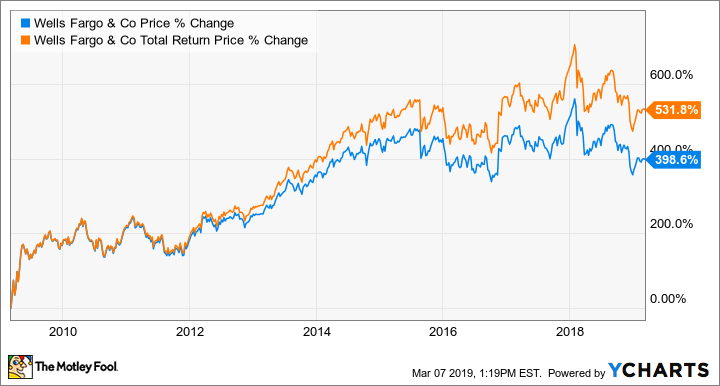
In the deal, investors received 0.1991 shares of Wells Fargo for each of their Wachovia shares. Assuming that they held on to those shares, they've received a total return of 531% since March 9, 2009. While Wachovia was sold at a fire-sale valuation, its stock wasn't nearly as diluted as was the case with some other institutions; shareholders who maintained their position are surprisingly almost back to even, when considering Wachovia's precrisis highs.

WFC Chart

WFC data by YCharts.

3. AIG: The classic "too big to fail" case

At the time of the financial crisis, American International Group (NYSE:AIG) was the world's largest insurance company. Unfortunately, losses on its mortgage-related investments and some other assets led to major liquidity concerns by the fall of 2018, and the company's survival was questionable. It was ultimately decided that AIG was "too big to fail," so the federal government authorized a series of massive credit lines to keep the company afloat.

AIG proceeded to shed some of its assets in order to reduce leverage and raise capital, and the company paid back all of its government assistance by March 2013.

As for its stock price, AIG has recovered nicely but still trades at a (split-adjusted) fraction of its precrisis levels. Since bottoming out in March 2009, AIG has generated a total return of nearly 700% for shareholders.

AIG Chart

AIG data by YCharts.

We could go on...for a long time

Between 2008 and 2012, there were 465 banks that failed. To cite some well-known examples, Lehman Brothers didn't survive, and Bear Stearns and Washington Mutual were acquired by stronger financial institutions. Countless others survived only with government help; Citigroup, whose situation was similar to that of Bank of America, was among this group.

The point is that this isn't an exhaustive list by any means. The stories above are simply three interesting examples of how some of the United States' major financial institutions (and their shareholders) have done since the market hit bottom a decade ago.

Friday, March 8, 2019

Avista (AVA) Upgraded to “Hold” by Zacks Investment Research

Zacks Investment Research upgraded shares of Avista (NYSE:AVA) from a sell rating to a hold rating in a report released on Wednesday morning.

According to Zacks, “Avista Corporation is an energy company involved in the production, transmission and distribution of energy as well as other energy-related businesses. Avista Utilities is its operating division that provides electric service customers and natural gas customers. Its service territory covers in eastern Washington, northern Idaho and parts of southern and eastern Oregon. Alaska Energy and Resources Company is an Avista subsidiary that provides retail electric service in the city and borough of Juneau, Alaska, through its subsidiary Alaska Electric Light and Power Company. “

Get Avista alerts:

A number of other analysts have also issued reports on the stock. Guggenheim reissued a hold rating and issued a $38.00 price target on shares of Avista in a research report on Friday, February 8th. Williams Capital upgraded Avista from a sell rating to a hold rating and increased their price objective for the stock from $40.00 to $41.00 in a report on Friday, January 4th. ValuEngine downgraded Avista from a buy rating to a hold rating in a report on Friday, January 11th. Finally, TheStreet downgraded Avista from a b- rating to a c+ rating in a report on Thursday, January 24th. Four analysts have rated the stock with a hold rating, Avista presently has an average rating of Hold and an average price target of $39.50.

AVA stock opened at $40.05 on Wednesday. The company has a quick ratio of 0.53, a current ratio of 0.54 and a debt-to-equity ratio of 1.02. Avista has a one year low of $39.75 and a one year high of $52.91. The stock has a market cap of $2.64 billion, a price-to-earnings ratio of 18.98 and a beta of 0.41.

Avista (NYSE:AVA) last posted its quarterly earnings data on Wednesday, February 20th. The utilities provider reported $0.70 EPS for the quarter, beating analysts’ consensus estimates of $0.60 by $0.10. Avista had a net margin of 9.77% and a return on equity of 7.78%. The company had revenue of $372.22 million during the quarter. Sell-side analysts predict that Avista will post 2.88 EPS for the current year.

The business also recently declared a quarterly dividend, which will be paid on Friday, March 15th. Shareholders of record on Friday, February 22nd will be issued a dividend of $0.3875 per share. This represents a $1.55 annualized dividend and a yield of 3.87%. The ex-dividend date is Thursday, February 21st. This is an increase from Avista’s previous quarterly dividend of $0.37. Avista’s dividend payout ratio (DPR) is 73.46%.

In other news, SVP Jason R. Thackston sold 2,875 shares of the firm’s stock in a transaction on Wednesday, March 6th. The shares were sold at an average price of $40.04, for a total value of $115,115.00. Following the sale, the senior vice president now owns 27,327 shares in the company, valued at $1,094,173.08. The sale was disclosed in a filing with the SEC, which is available at this hyperlink. Also, VP David J. Meyer sold 1,437 shares of the firm’s stock in a transaction on Tuesday, February 19th. The stock was sold at an average price of $41.34, for a total transaction of $59,405.58. Following the completion of the sale, the vice president now owns 2,396 shares in the company, valued at approximately $99,050.64. The disclosure for this sale can be found here. In the last quarter, insiders have sold 50,636 shares of company stock worth $2,070,250. Corporate insiders own 1.10% of the company’s stock.

Several institutional investors have recently made changes to their positions in the company. State of Alaska Department of Revenue lifted its position in Avista by 1.5% in the fourth quarter. State of Alaska Department of Revenue now owns 21,949 shares of the utilities provider’s stock worth $932,000 after purchasing an additional 315 shares during the period. Comerica Bank lifted its position in Avista by 0.5% in the fourth quarter. Comerica Bank now owns 63,953 shares of the utilities provider’s stock worth $2,636,000 after purchasing an additional 331 shares during the period. Commonwealth Equity Services LLC lifted its holdings in shares of Avista by 5.6% during the fourth quarter. Commonwealth Equity Services LLC now owns 7,562 shares of the utilities provider’s stock valued at $321,000 after acquiring an additional 404 shares during the period. GWM Advisors LLC lifted its holdings in shares of Avista by 4.7% during the fourth quarter. GWM Advisors LLC now owns 9,793 shares of the utilities provider’s stock valued at $416,000 after acquiring an additional 440 shares during the period. Finally, Raymond James & Associates lifted its holdings in shares of Avista by 5.3% during the fourth quarter. Raymond James & Associates now owns 9,521 shares of the utilities provider’s stock valued at $404,000 after acquiring an additional 476 shares during the period. Institutional investors and hedge funds own 80.36% of the company’s stock.

Avista Company Profile

Avista Corporation operates as an electric and natural gas utility company. It operates through two segments, Avista Utilities and AEL&P. The Avista Utilities segment provides electric distribution and transmission, and natural gas distribution services in parts of eastern Washington and northern Idaho; and natural gas distribution services in parts of northeastern and southwestern Oregon, as well as generates electricity in Washington, Idaho, Oregon, and Montana.

Further Reading: Limitations of the P/E Growth ratio

Get a free copy of the Zacks research report on Avista (AVA)

For more information about research offerings from Zacks Investment Research, visit Zacks.com

Thursday, March 7, 2019

Camping World Holdings Inc (CWH) Q4 2018 Earnings Conference Call Transcript

Logo of jester cap with thought bubble with words 'Fool Transcripts' below it

Image source: The Motley Fool.

Camping World Holdings Inc (NYSE:CWH) Q4 2018 Earnings Conference Call March 7, 2019, 4:30 p.m. ET

Contents: Prepared Remarks Questions and Answers Call Participants Prepared Remarks:

Operator

Please stand by. Good afternoon and welcome to Camping World Holdings' conference call to discuss financial results for the fourth quarter and fiscal year 2018. At this time, all participants are in a listen-only mode. Later, we will conduct a question and answer session and instructions will follow at that time. Please be advised that this call is being recorded and the reproduction of the call in whole or in part is not permitted without written authorization from the company.

Participating in today's call is Marcus Lemonis, Chairman and Chief Executive Officer, Brent Moody, President, Mel Flanagan, Chief Financial Officer, and Tom Wolfe, President of Good Sam Enterprises. I will turn the call over to Mr. Moody to get us started.

Brent Moody -- President

Thank you and good afternoon, everyone. A press release covering the company's fourth quarter and fiscal year 2018 financial results was issued this afternoon and a copy of that press release can be found in the investor relations section on the company's website. Management's remarks on this call may contain forward-looking statements within the meaning of the Private Securities Litigation Reform Act of 1995.

These remarks may include statements regarding our business goals, plans, abilities, and opportunities, industry and customer trends, growth and diversification of our customer base, and increase in market share, retail location openings, and acquisitions, and related expenses, increases in our borrowings, and anticipated financial performance. Actual results may differ materially from those indicated by these statements as a result of various important factors, including those discussed in the risk factors in our form 10-K and other reports on file with the SEC.

Any forward-looking statements represent our views only as of today and we undertake no obligation to update them. Please also note that we will be referring to certain non-GAAP financial measures on today's calls, such as adjusted EBITDA and adjusted earnings per share diluted, which we believe may be important to investors to assess our operating performance.

Reconciliations of these non-GAAP financial measures to the most directly comparable GAAP financial measures are included in our earnings release and on our website. All comparisons of our 2018 fourth quarter and fiscal year results are made against the 2017 fourth quarter and fiscal year results unless otherwise noted.

I will now turn the call over to Marcus.

Marcus A. Lemonis -- Chairman and Chief Executive Officer

Thanks and good afternoon, everyone. We appreciate your time and interest in our company, Camping World. In 2018, the company generated $4.8 billion in revenue, up $512 million or 12% from the previous year. Our RV salesforce also sold 104,296 RVs compared to 97,063 RVs in 2017.

After several years of very strong growth, our sales of new RV vehicles began to moderate in the second quarter of last year. While this trend accelerated through the end of the year, sales of used RVs were up in every quarter last year. As demand for new RVs softened throughout the second and third quarters, we reacted by lowering new RV inventory levels.

As the year progressed, the softening sales trends and excess RV inventory in the industry led to material margin compression. In the fourth quarter as the market continued to soften throughout the quarter, we made the decision to implement a more aggressive strategy at the expense of margin to further reduce inventory levels and to be better prepared for opportunistic inventory purchases in 2019. As a result of this strategy, we ended the year with our RV in stock inventory down 19% on a per dealership basis and more than $120 million on a same-store basis.

There will always be fluctuations in the sale of new RV inventory and we have built our RV sales business on a variable expense model to help mitigate the full effects of these fluctuations. Additionally, our RV service and collision business, our parts and aftermarket business, our used RV business, and our Good Sam consumer services and plans business primarily served the install base of the RV users and have historically experienced less fluctuations than the new RV market. That's why we put so much effort and so much emphasis on building our database and our Good Sam club, which are comprised of RV and outdoor enthusiasts.

In 2018, our company generated over 7.4 million transactions across thousands of products and services. We currently have over 5.1 million active RV and outdoor consumers, up from 3.6 million in 2017 and 2.1 million members in our Good Sam Club, up from 1.8 million in 2017. Both of them are all-time highs.

Additionally, our call center handled over 2.4 million calls and responded to over 420,000 emails and social media contacts and our various websites generated approximately 129 million visitor sessions last year. So, our various e-commerce platforms like goodsam.com, campingworld.com, ganderoutdoors.com, ganderrv.com, overtons.com, thehouse.com, and a variety of others.

I'm going to let Mel Flanigan take you through the numbers and then I'll come back to you with more details around our strategic priorities and initiatives for 2019 and take your questions. As most of you know, Mel was appointed to the CFO position as part of our management realignment in early January. He brings more than 15 years of public company CFO experience and a finance and accounting background of more than 35 years. He has already proven to be an unbelievable asset to our team and we're very pleased to have him as part of our executive leadership group.

Melvin Flanigan -- Chief Financial Officer

Thanks, Marcus and good afternoon, everybody. Let me start by acknowledging the timing of this call and the filing of the 12b-25. I want to be crystal clear that we take our filing responsibilities extremely seriously and we are laser-focused on getting the numbers right. The 12b-25 resulted primarily from an issue that the company found during our year-end review process that required additional work to assess and resolve.

Unfortunately, because the error was identified late in our process, that work simply could not be completed within the normal 60-day window. In the end, some of the immaterial adjustments to the prior year numbers were booked, all of which will be disclosed in our Form 10-K. As we disclosed in the 12b-25 filing and press release last week, the evaluation of our financial controls over internal reporting, we identified a new material weakness in our internal controls that existed at December 31st, 2018, specifically related to the sufficiency of technical resources at the company.

Simply stated, this means we plan to, among other things, add additional finance and accounting personnel to better support the organization. With respect to the weaknesses identified last year, we've remediated the issues related to the documentation and valuation process of trade-in units and the communication and documentation of certain accounting policies within the corporate accounting functions in our RV dealership business.

The issue related to accounting for income tax liabilities and related deferred income tax balances remains open as we continue to work toward remediation. We've begun a process to evaluate our resource needs and will be working diligently to address those needs as expeditiously as possible.

We finished the year with $4.8 billion in consolidated total revenue, up 12% from $4.3 billion a year ago. Consolidated gross profit was $1.4 billion, up 9.8% from $1.2 billion last year. On a percentage basis, gross margin came in at 28.4% compared to 29% last year. The decrease in gross margin is largely attributable to the margin compression associated with the reduction of inventory and a change in product mix.

Consolidated adjusted EBITDA was $313 million, down 20.7% from our very strong and all-time high performance in 2017. Pricing and margin compression in the new RVs component of our business, along with investments in our new store locations negatively impacted overall profitability.

Turning to segments, the Good Sam Consumer Services and Plans segment continues to do well, posting revenues after elimination of inner-segment transactions of $214 million in 2018, up 9.4% from $196 million last year. Gross profit was $127 million or 59.5% of revenues, up from $114 million and 58.2% last year.

In our RV dealership segment, revenues after elimination of inner-segment transactions grew 6.2% to $3.9 billion in 2018 and RV dealership gross profit increased 5.6% to $1 billion or 29.5% of revenue. Our RV and outdoor retail segment revenue after elimination of inner segment transactions was up 65% to $670 million, driven primarily from contributions from our Gander openings.

During 2018, we increased our RV and outdoor retail store footprint by over 46%, ending the year with a total of 212 stand-alone or cohabited locations and setting the stage for growth in the years to come. RV and outdoor retail gross profit was $225 million or 33.5% of revenues, up from $170 million last year.

For the fourth quarter, consolidated total revenue was $982 million, up 10.6% from $888 million a year ago and represents and all-time fourth quarter high for the company. Consolidated gross profit was $276 million, up 3.8% from $266 million last year. On a percentage basis, gross margin came in at 28.1% compared to 29.9% last year.

Consolidated adjusted EBITDA was $10 million, down from $64 million a year ago. This was primarily driven by margin compression from some of the more aggressive promotions at our RV dealerships taken late in the quarter to improve our inventory positioning and from losses in our fast-growing RV and outdoor retail segment. As Marcus discussed, we ended the quarter with inventory down 19% on a per RV dealership basis, with same-store inventories down more than $120 million.

In the fourth quarter, we also took a hard look at operations, inventory, various product and resrve assumptions, and given the market uncertainties took more measured positions in many of these areas. In the end, we increased our RV and outdoor inventory reserves by more than $5 million, increased insurance-related reserves by nearly $12 million, and wrote down $40 million in RV and outdoor retail segment good will as a result of our annual impairment testing.

Good Sam Consumer Services and Plans revenues in the fourth quarter after elimination of inner-segment transactions were $55 million, up 8.5% from $51 million last year. Good Sam Consumer Services and Plans gross profit was $34 million or 61% of revenue, up 8.9% from last year's fourth quarter.

RV dealership revenues in the fourth quarter after elimination of inner-segment transactions were $718 million, down 0.8% from $724 million last year. RV dealership gross profit came in at $185 million in Q4, down 1.6% from last year's fourth quarter.

In the RV and outdoor retail segment, fourth quarter revenues after elimination of inner-segment transactions were $209 million, up 84.7% from $113 million last year. Gross profit at our RV and outdoor retail locations was $57 million or 27.1% of revenues compared to $47 million and 41.1% last year.

Consolidated operating expenses increased 31.3% to $1.2 billion for the year, including a 25.3% increase in SG&A to $1.1 billion. The increase in operating expenses was primarily driven by incremental wages, selling, and associated overhead expenses related to the additional RV and outdoor retail locations opened over the past year, but was also impacted by the $40 million goodwill writedown I mentioned earlier, an $18 million increase in depreciation and amortization, a $17 million increase in retail pre-opening costs, and about $3 million in costs associated with store closings.

Other expense totaled $105 million in 2018 compared with other income of $30 million last year. $100 million of this change is attributable to the TRA liability adjustment booked in 2017. Additionally, floor plan and other interest expense was up a combined $31 million in 2018 due to both increased borrowing rates and higher average borrowings.

Net income was $66 million and earnings per share were $0.28 for the year ended December 31st, 2018. Adjusted earnings per share was $1.42 and adjusted EBITDA was $313 million for the year.

Turning to our balance sheet, we ended the year with cash and cash equivalent of $139 million and net working capital of $583 million. Total inventory was $1.6 billion, up 10.1% from a year ago. The $221 million increase due in part to the opening of new RV and outdoor retail locations was partially offset by an 8.6% decrease in new vehicle inventories overall or a decline of 19% on a per RV dealership basis from December 31st, 2017.

On December 31st, 2018, we had $1.2 billion of term loans outstanding under the senior secured credit facility, $886 million of floorplans notes payable under the floorplan facility, $39 million of borrowings under the floorplan facility's revolving line of credit, and $10 million outstanding under our real estate facility.

Looking ahead, we all saw the challenges faced by the industry accelerated in late 2018. Some of that softness has naturally spilled over into the first quarter. So, as we think about our expectations for 2019, we want to be cautious and need to factor in the uncertainties impacting our markets, especially this early in the year. Our initial outlook for 2019 is for total revenues in the range of $4.9 to $5.1 billion, and adjusted EBITDA in the range of $320 million to $340 million.

Looking at quarterly seasonality, we'd note that Q1 2018 is a particularly tough comp and we expect the uncertainty coming out of Q4 to bleed into Q1, after which we'd expect to see more typical seasonal trends kick in. With that, let me turn the call back over to Marcus.

Marcus A. Lemonis -- Chairman and Chief Executive Officer

Thanks, Mel. We're all glad to have you on board. Our comprehensive network of assets and offerings allows us to engage with consumers in a variety of ways. We're continuously developing ways to widen our customer funnel and increase our share of wallets across the RV and outdoor sector.

This includes expanding our RV and outdoor footprint through dealership acquisitions, building new RV and outdoor locations, and expanding our product and service offerings. It also includes building Gander RV into a prominent brand that will allow us to have the number one and number two dealership networks in the marketplace.

We've learned over the last several years that consumers start their RV shopping process online and more recently have gone deeper into that process, expecting more information, more digital communication, and the ability to transact in that process. We have seen the digital benefits of clearly defining trade areas and offering the customers choices in different buying experiences within the given market.

While Camping World's digital footprint is the clear number one ranked online brand, our desire to find new customers in new and existing markets led us to realize the importance of using our size, scale, and knowledge to create the number two RV brand dealer network in the nation.

At the beginning of the year, we made a number of organizational changes to better streamline our team and bring a renewed focus around these initiatives. Tom Wolfe, a senior executive who has been with the organization for more than 20 years was serving as the company's CFO and also leading the Good Sam business became the President of Good Sam enterprises and Mel Flanigan was hired to fill the CFO position.

Tom's appointment to President of Good Sam Enterprises gives this very important segment of our business renewed leadership to continue to develop and grow new products and services. I'm going to let Tom tell you about some of the Good Sam initiatives.

Thomas Wolfe -- President of Good Sam Enterprises

Thank you, Marcus, and good afternoon, everyone. The Consumer Services and Plans segment has always been focused on developing unique products and services to enhance the RV lifestyle. The Good Sam Club itself dates back more than 50 years and got its start as a group of RV owners who came together to share ideas and assist fellow members on the road. That original heritage of bringing people together, sharing ideas and resources is still core to the way we think about our consumer services and plans business.

Our Good Sam Club is the largest RV membership club in the world and we are leveraging our core competencies and infrastructure to extend our offerings into the outdoor community and broaden our membership base. The club members save up to 10% to 20% every day on a variety of products and services across Camping World, Gander Outdoors, and Overton's businesses as well as other special benefits such as free online shipping and member-only discounts.

Beyond the discounts, we are broadening all of our publications, blogs, websites, to include more content around outdoor and recreational activities. For example, our Good Sam directory now features information on parks with access to hiking trails, hunting areas, and boat launches, and our motorhome and trailer life magazines run regular features on a variety of outdoor products and activities.

Within the next few months, we will be expanding our customer financing options by rolling out a new private label credit card program that complements our existing co-branded credit card program. In addition to the financing offerings, both cards will allow customers to build loyalty points and receive additional benefits and discounts.

Within the roadside assistance and extended warranty programs, we are developing additional offerings that extend the reach of these services into the auto category, while at the same time leveraging our IT and call center infrastructure. On the marketing side, we are focused on analyzing buying habits and spending patterns to personalize our offerings and communications around the unique interests of our club members.

With 2.1 million Good Sam club members and 5.1 million active customers across our platform, we have a tremendous opportunity to continue expanding our consumers and plans business and broadening our reach within both the RV and the outdoor community.

Now, I'll turn the call back over to Marcus for his closing comments.

Marcus A. Lemonis -- Chairman and Chief Executive Officer

Over the last 17 years, I have grown more and more confident in this industry and its long-term growth potential. As Mel outlined our forecast for 2019, our management team and our entire staff is focused on achieving those results. Thanks, everyone for your time today, this concludes our prepared remarks. We're now reading for the question and answer session.

Questions and Answers:

Operator

Thank you. If you would like to ask a question, please signal by pressing *1 on your telephone keypad. If you're using a speakerphone today, please make sure your mute function is turned off to allow your signal to reach our equipment. Once again, please press *1 at this time to ask a question.

We'll take our first question from Rick Nelson with Stephens. Please go ahead.

Richard Nelson -- Stephens -- Analyst

Thanks. Good afternoon. Marcus, if you could comment on sales trends you saw during the quarter, some of our RV checks were suggesting December got quite difficult in the early going of 2019, what you're saying and how you see the year unfolding.

Marcus A. Lemonis -- Chairman and Chief Executive Officer

Yeah. What was odd about the fourth quarter was October, the last half of October got really rough and then November had a mild bounce-back and then December, the bottom really fell out. It didn't catch us by surprise because we started preparing for it, but we have seen a softening in the first quarter of 2019 compared to 2018, but we have not seen a softening in online lead generation or foot traffic, just transactions. So, we're hopeful that the first quarter was a big quarter to come. December of '17, January of '18, February of '19, and the first half of March of '18, they were good. They were really solid last year. In fact, it was our best 75, 80 days.

We have seen, though, Rick, the return to a small degree, a stabilization of our margins. We're not seeing the kind of margin erosion we experienced in October, November, and December, and while it isn't where we want it to be, we think it will improve. We think some of that margin is the inventory channel sort of restocking and it's the fact that we de-stocked so aggressively in the back half of 2018 that we were able to be opportunistic with our buys and be better-positioned with our inventory.

Richard Nelson -- Stephens -- Analyst

It sounds like you're comfortable with your inventory levels down 19% on a per store basis. Do you think the channel inventory is also getting cleaned up?

Marcus A. Lemonis -- Chairman and Chief Executive Officer

I can't speak to the channel. We are monitoring the inventory literally every morning based on the sales trends from the previous day, looking at our orders, making sure that we stay on a 24-hour basis to not have -- if we see any increase or decrease in any sales trends, we're going to adjust our inventory real time.

At this moment in time, we're comfortable with where our inventory levels are on the new side, but are aggressively pursuing inventory on the used side, particularly since quarter after quarter last year, our used business was up and we think that's a perfect opportunity for us to mitigate any softness on the new side.

Richard Nelson -- Stephens -- Analyst

Great. Finally, if I could ask about Gander Outdoors, if you could quantify the magnitude of the loss in the period and just an update on the RV stores and how they're performing.

Marcus A. Lemonis -- Chairman and Chief Executive Officer

I'll take the first half and have Mel answer the second half. We today only have 56 Gander outdoor locations open. We closed seven, as we said we would. We're obviously always monitoring those. We are pretty close in the next 60 to 90 days to having approximately half of those locations selling RVs. We're opening literally as the snow melts. We are noticing the stores that we're adding RVs too, keep in mind, also have the full RV parts and accessories assortment.

The management team has been consolidated and so, we no longer are managing Gander Outdoors and Camping World's RV and outdoor retail business separately. We have one individual with the managing team that's doing that. Additionally, we consolidate, in addition to closing the seven Ganders, we closed two Camping World locations that weren't profitable and three dealerships that weren't profitable and we consolidated our four distribution centers down to three.

Today, now that all of the inventory is in Oracle, both the Camping World and Gander Outdoors retail locations and the campingworld.com and Gander Outdoors and Gander RV online businesses are all selling all of the products. So, we're now looking at this business more holistically saying they're really not different rather than modest assortments of some of the categories, but they are both now well-positioned to be full-throttle RV businesses with complementary RV and outdoor accessories to drive traffic and to drive transaction counts.

I'll have Mel address the Gander question.

Melvin Flanigan -- Chief Financial Officer

Yeah. I think we'll be filing the 10-K within the next couple of days and that's where we'll put out all of our segment information. I think it's safe to say that losses in the retail segment overall, which obviously includes Gander and Gander is a big driver there, was significant for the year, but I think everybody understands, at least I hope everybody understands that you're talking about a business that added a number of locations, 46% increase in footprint over the year.

And as we ramp that up to sales, we're going to be able to cover more of the overhead efficiently and we'll see things start to turn. It was a significant loss. We'll see it in the segment disclosures in the K.

Marcus A. Lemonis -- Chairman and Chief Executive Officer

That significant loss, I think, may include the goodwill adjustment as well as the decision we made to inventory reserve, correct?

Melvin Flanigan -- Chief Financial Officer

Sure, of course.

Marcus A. Lemonis -- Chairman and Chief Executive Officer

That's important, Rick, to note that.

Richard Nelson -- Stephens -- Analyst

The guidance of $320 million to $340 million EBTIDA, what would that assume about Gander in 2019?

Marcus A. Lemonis -- Chairman and Chief Executive Officer

We're not looking at Gander specifically in a vacuum. We're looking at our retail segment, our RV and outdoor retail segment and we're looking at our RV dealership segment. Because everything has been collapsed and because both sell RVs now and because both have RV and outdoor products, we're not looking at it the same way. We'll to aa little more research and come back to you if you're looking for specific location information.

Richard Nelson -- Stephens -- Analyst

Thanks and good luck.

Operator

We'll take our next question from Craig Kennison with Baird. Please go ahead.

Craig Kennison -- Robert W. Baird & Co. -- Analyst

Thanks for taking my question. Just to follow up on Rick's question on your EBITDA guidance, can you help us understand what is excluded from any sort of costs related to Gander or anything else to get to your adjusted EBITDA number?

Marcus A. Lemonis -- Chairman and Chief Executive Officer

For 2018 or for 2019?

Craig Kennison -- Robert W. Baird & Co. -- Analyst

For 2019.

Marcus A. Lemonis -- Chairman and Chief Executive Officer

There are no add-backs in the 2019 number because the stores are now open. So, in that number, in that range of $320 million to $340 million, includes all of the payroll, all of the operating expenses, the distribution centers, all of our dealership business, it includes everything with no add-backs.

Craig Kennison -- Robert W. Baird & Co. -- Analyst

That would include pre-opening costs? I know that was a drag in 2018 related to Gander.

Marcus A. Lemonis -- Chairman and Chief Executive Officer

There are no pre-opening costs that I can think of for the 2019 number.

Craig Kennison -- Robert W. Baird & Co. -- Analyst

Okay. Maybe to further unpack your 2019 guidance, can you give us a feel for what your expectations are for gross margin and SG&A?

Marcus A. Lemonis -- Chairman and Chief Executive Officer

We're not at this time comfortable providing that level of guidance. We do expect our margins to improve over 2019 because if we manage our inventory like we are at this moment, we don't believe we'll have the margin compression associated with the liquidation of that inventory. Additionally, with more time to prepare for both the spring, summer, and fall seasons, we're able to better prepare for one-time buys and special buys and margin builders in our retail business and we expect our Good Sam business to continue to contribute high margins to our business.

Craig Kennison -- Robert W. Baird & Co. -- Analyst

And then one more on guidance, are there any transactions or acquisitions included in your guidance or would that be additive?

Marcus A. Lemonis -- Chairman and Chief Executive Officer

There are no transactions included in our guidance. However, we are in the process at different stages of acquiring multiple stand-alone RV dealerships throughout the country, as we have said in the past. As long as we have available cash for the company, we're going to be looking for opportunistic acquisitions in markets where we feel like there's either a) whitespace or b) a market share opportunity. So, we are still heavily focused on growing our RV dealership platform.

Craig Kennison -- Robert W. Baird & Co. -- Analyst

That's great. And maybe just as a final question related to that, as you think about capital allocation, you still have the consolidation opportunities in front of you. You've also got a stock that's trading at a discount to where maybe historically it's been. Is there any trade-off consideration of a buyback relative to acquisitions?

Marcus A. Lemonis -- Chairman and Chief Executive Officer

So, our focus as a management team for 2019 is to bring cash back into the system and there's really three principal ways that we want to do that. Number one, we are taking a very draconian approach to capex in 2019, essentially investing in the maintenance of our facilities to ensure the safety of our customers and our associates. Number two, any technology enhancements, no new initiatives would drive that capex number much past the maintenance level.

Number two, we are laser-focused on driving down the current level of our retail inventory. We believe the warehouse consolidation along with shared resources between the different businesses will allow that to bring a lot of cash back in. Then the third is obviously our results. As we think about using our cash flow, whether from operations or from reducing inventory, we think about it principally in three ways. One, for 2019, we definitely want to put on our radar the reduction of debt.

We would like to focus on de-levering our company when it makes sense. Number two, we will always look at other opportunistic acquisitions that make sense, that fit in, that are purely in the RV dealership business space, and then third, with that excess cash flow, as you know, we provide a dividend. We have a tax distribution to make. And if the board sees it appropriate, then consideration will be given to a share buyback. At this moment in time, de-levering the company and looking for RV dealership opportunistic buybacks are primarily our focus.

Craig Kennison -- Robert W. Baird & Co. -- Analyst

That is clear. Thank you so much.

Operator

We'll take our next question from Fred Whiteman with Citi. Please go ahead.

Fred Whiteman -- Citigroup -- Analyst

Hey, guys. Last quarter, you had talked about getting more aggressive, both in terms of buying and selling inventory. It sounds like that happened. Could you just walk through the progression of the quarter from a promotional and then internally how that played out versus your expectations?

Marcus A. Lemonis -- Chairman and Chief Executive Officer

We really started with me making the decision that I wanted to restructure how the company was being managed at the time. In the fourth quarter, I took the keys back specifically to the day to day operations of our RV dealership business, which included all of the promotions, all of the inventory, the closure of certain stores, and made that conscious decision with the senior management team that manages the inventory to get VIN-specific, type-specific, and manufacturer-specific on liquidating inventory that we felt wasn't going to do us any favors in 2019.

As we did that, we were very specific about the markets and the types. At the same time, we were working with our key manufacturers to provide opportunities to us to replace inventory at a lower cost in some cases. So, while we ended the year with significantly lower inventory, what we generated in the way of revenue in the fourth quarter of 2018, we replaced that inventory with what we think is far better inventory. We will never take our foot off the gas again of managing our inventory with a tighter day supply focus and a tighter type VIN-specific focus.

What that comes with is an opportunity to buy in a more calculated way. I think the reason we have seen a stabilization of our margins in the early part of the first quarter and hopefully an increase as the year progresses is because of those two factors.

Fred Whiteman -- Citigroup -- Analyst

Great. The interest rate environment has leveled off a little bit, but I think in the past, you mentioned you were going to be thoughtful for the assumptions behind your 2019 guide. Can you just explain what you guys have baked in either from a floorplan perspective or just at the consumer level for 2019.

Marcus A. Lemonis -- Chairman and Chief Executive Officer

For 2019, I think we factored in a no interest rate hike because we don't want to act like we have a crystal ball into it, but we did factor in keeping our inventory a lot tighter, so we're looking to reduce our floorplan expense by keeping our inventory tight and that's where we speculate on where the rates are going.

Fred Whiteman -- Citigroup -- Analyst

Thank you.

Operator

Moving on, we'll take our next question from Tim Conder with Wells Fargo Securities. Please go ahead.

Tim Conder -- Wells Fargo Securities -- Managing Director

Thank you. Just a couple here. Marcus, I'll follow on what's baked into the assumptions here. If I heard Mel right -- Mel, welcome aboard -- you said $4.9 billion to $5 billion in revenue and $320 million to $340 million in adjusted EBITDA, was that correct?

Melvin Flanigan -- Chief Financial Officer

Yeah, $4.9 billion to $5.1 billion.

Tim Conder -- Wells Fargo Securities -- Managing Director

Oh, $5.1 billion. Okay. Within that, from a comp store sales basis, I think that's been a big concern among investors and many of us that argue you guys are consolidating, making acquisitions, but is there cannibalization going on? Is the ability just to hold share or really gain share with these acquisitions? Given the state of the industry, again, you're focused on keeping capex minimized, would it maybe be better off here at least in '19 to maybe push the acquisitions off a little bit and focus on really honing up what you have?

Marcus A. Lemonis -- Chairman and Chief Executive Officer

Thank you for your questions. I'm going to separate the issues. You're making good points. They are separate things. First off, our acquisitions have to be very opportunistic and they have to present either a clear whitespace opportunity or something that is a market that is on fire that maybe didn't see a decline in 2018. I think when people ask us about our market share, what we learned in 2018 and quite frankly even in the first month of 2019 is that we do have some proximity of stores.

So, part of that strategy is bifurcating our brands between Gander RV, which could be a stand-alone dealership, and Camping World, because we know that the customer transaction starts online. As we look at the data and we look at our lead volume, we know that we can differentiate up and we can differentiate the product enough in the same market to be able to capture more share.

We don't believe that we had as much cannibalization as some people believe. In fact, the stat surveys came out today that I think validated that the market was down in December and it validated that it was down in November. I don't think it's something that is toward us. Remember, the stat survey numbers are directional in nature. I'm not sure that anybody has ever audited the specificity of the number, but we know that directionally it's correct.

As we think about our business and where it's going directionally and we think about where the manufacturers are, we find that to be a better guide of where the industry is and it is true that the market is softer, but it is softer relative to 2017. It still is going to deliver more results from a transactional standpoint than '16 and '15. I don't know that we're necessarily feeling like the sky is falling.

I do appreciate the comment about focusing on what we have. We feel like we have very tight focus, particularly with the bifurcation of the Camping World RV brand and the Gander RV brand.

Tim Conder -- Wells Fargo Securities -- Managing Director

What are your expectations from the industry and then what type of comp store sales do you have baked in to the revenue numbers?

Marcus A. Lemonis -- Chairman and Chief Executive Officer

I don't have an expectation for the industry, but we have predicted in our numbers a negative same-store sales number on the new side of 3% to 4%.

Tim Conder -- Wells Fargo Securities -- Managing Director

Okay. To your statement earlier about the variable cost structure, given there's been a lot of changes and Gander has been added on, any comments you can make -- I think at the IPO time, you said your variable cost structure was roughly 70%, how do you see that now within the RV operations or on a consolidated company? How is that now?

Marcus A. Lemonis -- Chairman and Chief Executive Officer

I actually feel like with the management changes that I made in the last 75 days, I feel more confident about the variability of our model than I did and I saw the fruits of that labor in January and February when I looked at the gross margins and the net income as it related to how much the revenue was up or down.

January was softer on a topline basis than January of 2018. February was softer on a topline basis than it was in February 2018, but our margins were better. We feel like the changes that we made on the expense side proved our thesis with how the bottom line actually ended up in those two months.

Tim Conder -- Wells Fargo Securities -- Managing Director

Okay. Then two more briefly, if I may -- how are you thinking about -- units are thinking about down 3 to 4 in comp store sales basis. Do you anticipate taking your RV inventories at the company level lower than where they ended the year as we look forward to year end '19? Would we expect that on a same-store basis?

Marcus A. Lemonis -- Chairman and Chief Executive Officer

I'm not convinced. I'm sorry, Tim, I should have been more clear -- we believe that our new inventory sales is where our problem is going to be. The projection that we've made internally about a dip in new inventory is the equivalent sort of assessment we've made in how we think our used inventory can mitigate some of that.

We've already taken our new inventory levels down to a level that we believe matches the projects that we have. If we see any change in that pattern up or down, we will adjust accordingly, but our current inventory levels account for the projection of the new inventory business being down for the year by that percentage that I previously mentioned.

Tim Conder -- Wells Fargo Securities -- Managing Director

Then the second question was related to the EBITDA. If I take the best case scenario there, you were kind of coming up with about a 6.9% EBITDA margin, which we haven't seen in a while, if you take out '18, of course. How do you see that progressing back to that goal that you had of 8%. How should we think about that? Are we looking at two, three-year type of timeframe?

Marcus A. Lemonis -- Chairman and Chief Executive Officer

Brent and I will continue to dial in to the SG&A. We're obviously doing that more feverishly right now trying to get back that EBITDA margin where it belongs. I can't speculate whether it's going to take us two years or three years because it would require me to speculate on how long I expected the softness in the new side of the business to last.

We know that we can mitigate some of that and our goal is to use our parts and service business, our collision business, and our Good Sam business, and our used business to mitigate some of that delta and raise that up because obviously, those things that I just mentioned have a higher gross margin.

So, if you can drive more high-margin products on a lower revenue base, you're going to have a higher gross margin if you can control your expenses and we should be able to find ourselves inching our way back up there. I don't want to be below 7%. That's a personal goal of mine. I have to be realistic about what the numbers tell us that are on paper in front of us right now.

Tim Conder -- Wells Fargo Securities -- Managing Director

Okay. Thank you for the time.

Operator

And once again, that's *1 if you'd like to ask a question on today's call. We'll hear next from James Chartier with Monness, Crespi, & Hardt. Please go ahead.

James Chartier -- Monness, Crespi, Hardt & Co. -- Analyst

Thank you for taking my question. Could you just talk about the retail gross margin performance in fourth quarter? It's down significantly versus a modest decline in third quarter. What drove that? Then any kind of learnings you had on the assortment at Gander that maybe changed for 2019 there.

Marcus A. Lemonis -- Chairman and Chief Executive Officer

So, two things -- there were more outdoor products sold in the fourth quarter as a percentage of the total than RV products sold, in comparison to the third quarter. That mix changes it. The Gander business has high volume. While we're working to install more RV and outdoor products, even now that Gander has the full assortment that Camping World has in its box, some of the SKUs and some of the categories inside of the box innately come with a lower margin and their volume is accelerated.

Secondly, I made the decision to accelerate the reduction of retail inventory as well. We expect that in the coming fourth quarter of 2019, those retail margins will have a nice increase over 2018 because I won't be looking to liquidate inventory. We closed nine stores as well. In some cases, we were liquating inventory. So, you're comparing total retail segment margins in '18 when we didn't have many Gander stores open to total retail segment stores in '18 when we did have them open. We think it will get better as we move forward.

What I learned from the assortment is that we have been able to attract a historical RV customer to these boxes. Obviously, we want to get more of them. They are eating up the RV and outdoor product that typically exists in Camping World. That should help with the margins. On the flip side, we've learned a lot of the assortment with Gander has played out nicely in some of the Camping World stores, which is why we started to look at them to be the same business with two names on them.

James Chartier -- Monness, Crespi, Hardt & Co. -- Analyst

Quickly, what's your expectation for ASP trends in 2019? Should we expect similar declines as we saw in '18?

Marcus A. Lemonis -- Chairman and Chief Executive Officer

That's a really great question. It will depend on where that first-time buyer travel trailer customer lives and how that balances out against our used sales. I would hope it would maintain some level of similarity and in the first two months of 2019, they look pretty similar to what they looked like a year ago.

James Chartier -- Monness, Crespi, Hardt & Co. -- Analyst

Thanks. Best of luck.

Operator

We'll take our next question from Ryan Brinkman with JP Morgan. Please go ahead.

Ryan Brinkman -- JP Morgan -- Analyst

Hi, thanks for taking my question. What do you think are the primary factors driving the trend of lower retail demand for new RVs included as the economy in demand for new light vehicles appears to have held out much better relative to demand for RVs?

Marcus A. Lemonis -- Chairman and Chief Executive Officer

I don't want to speculate on the industry. The one thing I have to be honest with myself about is 2017 was just a record year. I think as a company, forget the industry, we have to find new people to bring to the industry. As we understand the trade cycles and as we understand how to bring in first-time buyers to the market, there's definitely something that we have to crack the code on.

I can't speak to whether the trade and tariffs and that overall macro piece affected it or the stock market movements affected it, I can't speak to it. I'm not an economist. But we know we saw a softening in comparison to the red, red hot numbers that we saw throughout '17 and in the first quarter of '18.

What's interesting is if we look at our projection for 2019, if we had never had '17 happen, it would still be a pretty good year. What we have to do is take that pretty good year and make it better, make it better by having better margins and make it better by driving our expenses even further down and eliminating those assets and those locations or those initiatives that don't give the shareholders the return on investment that they're looking for.

Ryan Brinkman -- JP Morgan -- Analyst

Thanks. I heard you say you expected your same-store unit sales to be down potentially 3% to 4% in 2019 and you also didn't want to necessarily express the view on industry unit sales. How, though, do you think Camping World is positioned to perform relative to the industry in 2019, including because I think most industry new unit forecasts are for a steeper decline than 3% to 4%? Are you expecting to gain share?

Marcus A. Lemonis -- Chairman and Chief Executive Officer

We're expecting to accelerate our effort in our used business and we believe that the used business could help mitigate some of what people say the industry trends are. We have seen the fruits of that in the first two months of the year. So, as we drive down our retail inventory, Brent's and my goal is to redeploy some of that capital to our used inventory and we have plenty of floorplan facility capacity to drive our used business. There were moments in time in the past where our used was 60-40 new to used.

We want to drive our business back to maybe not that number, but we know we have room for opportunity on the used side. Because of our network, because of our size, because of our balance sheet, because of our floorplan facility and because we chose to liquidate inventory in the fourth quarter and not have curtailments and marching compression in the first six months of this year, we think we're well-positioned to invest that capital in youth and be opportunistic on the new side.

Ryan Brinkman -- JP Morgan -- Analyst

Thanks. Last question -- earlier, there was a discussion of the margin for the whole company on an EBTIDA basis in 2019 and you're not provided a breakout for gross profit margin, gross profit dollars by segment, etc. But can you talk about what, in general, your assumptions are for the largest dealership segment, including because I think one of the attractive parts of this business model is that there wouldn't be a lot of operating leverage to the downside in downturns. It looks like maybe you are baking some in in 2019.

Can you talk about why maybe the margin degradation hasn't been a little bit steeper than you thought it would be in dealership? Is that because of the unexpected pace of the slow down? But once we get to a lower level of RV sales, then the margin can stabilize as you cycle pass inventory reduction? How do we think about industry trends' impact on your dealership margin from the industry trends in 2019?

Marcus A. Lemonis -- Chairman and Chief Executive Officer

Our internal management target is to return the dealership gross margins to historical levels. You do that principally by doing three things. Number one, you don't get yourself in inventory trouble. I believe that as an industry, we got ourselves in trouble and that cost us dearly by having to liquidate that inventory. I think that's step one. I think step two is we have to be more opportunistic and more strategic about what we're buying on the new side and partner with manufacturers that are focused on turns and margins and not anything else. We think Thor, Winnebago, and Forest River are those companies.

Third, we believe that we can make up some ground on the use side because on a transactional basis, a used sale just on its own could have anywhere from 2 to 3 percentage points more in gross profit. As that mix shifts, we believe we'll be able to make up some ground, but internally, our team's plan and our focus is on returning the dealership's gross margins to their historical levels even if the topline is softer.

Ryan Brinkman -- JP Morgan -- Analyst

Okay. So, that does suggest that the retail segment will be quite soft, most likely, in 2019, backing into the dealership margins are potentially...

Marcus A. Lemonis -- Chairman and Chief Executive Officer

I would not make that assessment or that assumption. As Mel pointed out, we don't know where the market is going to go. We want to be cautious in our range. We are very focused on margin as a company, but as we have said in the past, we are also very focused on driving transaction count, which feeds our Good Sam business, and driving transaction count, which gives our RV salesforce an opportunity to talk to people. We need to draw a line in the sand and make sure that people understand that we're here. We did sell 104,000 units last year.

Obviously, our goal is to exceed that number. I will not miss a deal understand any circumstance and I told my staff that, that we will not miss a deal. As I work deals on a case by case basis or I work trades on a case by case basis, there may be deals that we take that are a little slimmer, but I don't want anybody to make assumptions because we're not giving segment guidance. I'm just telling you what our internal goals are.

Ryan Brinkman -- JP Morgan -- Analyst

Got it. Thank you very much.

Operator

We'll take our next question from David Tamberrino with Goldman Sachs. Please go ahead.

David Tamberrino -- Goldman Sachs -- Analyst

Thanks for taking our question. I know you pointed out the variable cost or expense business model that you have. I'm just curious as I look through the fourth quarter's results, sales were a little bit weaker than what people were expecting, but SG&A was up quite nicely year over year, 213 to 264 in that zip code. I'm wondering if that's elevated because of the Gander spend or if there's anything in particular that occurred in the quarter that would have kept that a little bit elevated and you weren't able to react?

Marcus A. Lemonis -- Chairman and Chief Executive Officer

Yeah. That's a great question. In addition to the outdoor locations we opened, we also had 25 more dealerships on the books in December of 2018 than we did in 2017. What we're always focused on is what is our SG&A as a percentage of our gross profit. It is true that we were up in that metric. The reason we were up in that metric is because our gross profit was severely impacted through our decision to strategically lower our inventory.

As we move into 2019, I feel very confident that we have made significant position and pay plan modifications that allow 2019 to show you the variability in our SG&A model. Keep in mind that some of our brand new dealerships, whether they're called Camping World or Gander RV have newness to them. When we make an acquisition, there are some costs associated with them. But the scale of newness of expenses in 2019 compared to '18, I think you'll be pleased with what the ratios look like as a percentage of gross profit.

David Tamberrino -- Goldman Sachs -- Analyst

Okay. And then our second question just on Gander Mountain, now Gander Outdoors -- it was a troubled retailer a couple of times before. Now, I think you've shut down a handful of stores that you didn't see a way forward with them. What is it about this business, the products that are sold inside the store, that has created or continues to create these unprofitable locations, just unprofitable stores within that franchise, legacy or not?

Marcus A. Lemonis -- Chairman and Chief Executive Officer

I don't know how to answer the question. I'm sorry. I don't understand the question.

David Tamberrino -- Goldman Sachs -- Analyst

Correct me if I'm wrong, but Gander Mountain, you acquired the stores out of a bankruptcy. They used to have like 120 or 160 stores. You're going to have 70 open.

Marcus A. Lemonis -- Chairman and Chief Executive Officer

No, actually, we have 56 open. We closed 7.

David Tamberrino -- Goldman Sachs -- Analyst

Correct. What I'm asking is what have you found from those seven that you closed, the issues with the business that you weren't able to make it profitable?

Marcus A. Lemonis -- Chairman and Chief Executive Officer

I think when we looked at the locations, we were only looking for of the 170 locations, we were looking for locations we felt filled voids in specific geographic markets, allowed us to integrate our RV business into them or had a path to profitability and database growth, both for the club and for other products, that were clear. I didn't want to wait to react too late on the ones that I didn't feel had that path and we're always monitoring them.

I feel strongly that Gander RV and Gander Outdoors is a nice complement to Camping World. Whether that's in certain states or certain markets, whether that's in markets where there's already a Camping World, we believe the RV and outdoor consumer is one and the same and that the offering inside of these stores looks pretty similar. If you went on to campingworld.com and you started to visit some of the Camping World locations, you would see the offering at campingworld.com and some of the locations look similar.

Our company is an RV company first and an RV and an RV and outdoor products and accessory business second. We know that the RV and outdoor products are bait, both for our database, for our club, and for our RV business. We've seen the fruits of that in multiple markets. If over time, we have Camping World locations that don't sell RVs or Gander locations that don't sell RVs that can't be profitable in their own right, we'll close them.

But ultimately, we now believe we have one clean business, which is an RV and outdoor company, principally driven by the sale and service and financing of RVs, principally driven by its annuity business, which is Good Sam, which is why the company went from 1.8 million to 2.1 million in members. But we do not and have never wanted to be a big box retailer. That is not our goal.

David Tamberrino -- Goldman Sachs -- Analyst

Thank you for the time.

Operator

Thank you. That concludes today's question and answer session. I would like to turn the call over to Mr. Lemonis for any additional or closing remarks.

Marcus A. Lemonis -- Chairman and Chief Executive Officer

Thanks for your time today. We look forward to speaking with you and releasing our first quarter resuls in the near future. Take care.

Operator

Once again, that does conclude today's conference. Thank you for your participation. You may now disconnect your phone lines.

Duration: 63 minutes

Call participants:

Marcus A. Lemonis -- Chairman and Chief Executive Officer

Brent Moody -- President

Melvin Flanigan -- Chief Financial Officer

Thomas Wolfe -- President of Good Sam Enterprises

Richard Nelson -- Stephens -- Analyst

Craig Kennison -- Robert W. Baird & Co. -- Analyst

Fred Whiteman -- Citigroup -- Analyst

Tim Conder -- Wells Fargo Securities -- Managing Director

James Chartier -- Monness, Crespi, Hardt & Co. -- Analyst

Ryan Brinkman -- JP Morgan -- Analyst

David Tamberrino -- Goldman Sachs -- Analyst

More CWH analysis

This article is a transcript of this conference call produced for The Motley Fool. While we strive for our Foolish Best, there may be errors, omissions, or inaccuracies in this transcript. As with all our articles, The Motley Fool does not assume any responsibility for your use of this content, and we strongly encourage you to do your own research, including listening to the call yourself and reading the company's SEC filings. Please see our Terms and Conditions for additional details, including our Obligatory Capitalized Disclaimers of Liability.

10 stocks we like better than Camping World HoldingsWhen investing geniuses David and Tom Gardner have a stock tip, it can pay to listen. After all, the newsletter they have run for over a decade, Motley Fool Stock Advisor, has quadrupled the market.*

David and Tom just revealed what they believe are the ten best stocks for investors to buy right now... and Camping World Holdings wasn't one of them! That's right -- they think these 10 stocks are even better buys.

See the 10 stocks

*Stock Advisor returns as of March 1, 2019