Tuesday, March 31, 2015

Will Toll Brothers Boom in Housing's Recovery?

On Wednesday, Toll Brothers (NYSE: TOL  ) will release its latest quarterly results. The key to making smart investment decisions on stocks reporting earnings is to anticipate how they'll do before they announce results, leaving you fully prepared to respond quickly to whatever inevitable surprises arise. That way, you'll be less likely to make an uninformed, knee-jerk reaction to news that turns out to be exactly the wrong move.

The housing market has started recovering much more quickly in recent months, making investors incredibly optimistic about the prospects for Toll Brothers and its homebuilding peers. But have the industry's stocks gotten ahead of their fundamentals? Let's take an early look at what's been happening with Toll Brothers over the past quarter and what we're likely to see in its quarterly report.

Stats on Toll Brothers

Analyst EPS Estimate

$0.07

Change From Year-Ago EPS

(30%)

Revenue Estimate

$511.06 million

Change From Year-Ago Revenue

37%

Earnings Beats in Past 4 Quarters

3

Source: Yahoo! Finance.

Will Toll Brothers see an earnings rebound this quarter?
Analysts haven't shared the general enthusiasm about housing in their earnings estimates on Toll Brothers, having slashed their April-quarter estimates by nearly two-thirds and cutting $0.16 per share from their full-year fiscal 2013 consensus earnings figures. The stock also hasn't moved very far lately, falling about 1% since mid-February.

Enthusiasm among homebuilders has been extremely strong lately, as favorable data on the housing front has lifted many stocks substantially in recent months. Late last month, D.R. Horton (NYSE: DHI  ) saw sales jump nearly 50%, as profits jumped nearly 175% in its most recent quarter. Smaller builders like Hovnanian (NYSE: HOV  ) , which suffered disproportionately hard during the housing bust, have recovered the most sharply. Hovnanian's stock quadrupled in 2012, and while it's down a bit year to date, it has still held onto massive gains compared to its peers.

But Toll Brothers hasn't seen nearly the magnitude of gains that its fellow homebuilders have enjoyed. In its fiscal second-quarter results announced in February, Toll Brothers fell short of expectations despite seeing signed contracts rise by 49%. Although the company noted increased demand and building momentum in its business, average selling prices fell 2%, and investors have held back on Toll Brothers and favored other, smaller homebuilder stocks.

Interestingly, Toll Brothers has decided to move beyond outright sales to promote luxury rentals. In a partnership with AECOM's (NYSE: ACM  ) Capital investment fund, Toll Brothers announced last month it would develop a 417-unit rental tower in Jersey City, with leasing expected by early 2015. The building is the first of a planned complex that will include 925 residential units, along with a performing arts center, retail space, and a pedestrian plaza. Given Toll Brothers' focus on luxury, catering both to renters and buyers makes sense for the company.

In Toll Brothers' report, look at whether the company is able to sustain growth at rates similar to what middle-end homebuilders have managed lately. If the luxury end of the housing market is struggling, it could have ramifications not just for Toll Brothers but for the U.S. economy as a whole.

The best investing approach is to choose great companies and stick with them for the long term. The Motley Fool's free report "3 Stocks That Will Help You Retire Rich" names stocks that could help you build long-term wealth and retire well, along with some winning wealth-building strategies that every investor should be aware of. Click here now to keep reading.

Click here to add Toll Brothers to My Watchlist, which can find all of our Foolish analysis on it and all your other stocks.

The Week Ahead: Bubble Top or Buying Opportunity?

Many analysts feel we're witnessing a bubble formation, like that which formed, and burst, in 2000, but MoneyShow’s Tom Aspray shares why he feels it's too early to make that call, given the differences between the two markets.

The long awaited Twitter IPO did better than expected, as it closed Thursday 70.8% above the initial offering price. The S&P futures had turned lower by the opening, and closed very weak. It appeared that someone was paying attention to the financial networks and their segments on whether it was a “stock market bubble.”

This discussion may have been in reaction to comments on October 29, by BlackRock’s Chief Executive Officer Laurence D. Fink, who said “Fed policy is contributing to bubble-like markets, such as the surge in stock prices.” BlackRock manages a reported $4.1 trillion in assets, which makes it the world’s largest money manager.

Two other long-term bulls, Edward Yardeni and Laszlo Birinyi, according to the New York Times, are concerned that the current complacency would lead to a “melt-up” in stock prices. They both think a correction of 10%, or so, would be healthy, as it should  set the stage for even higher prices.  Edward Yardeni has an S&P target of 2014 for next year.

chart

In my opinion, the last real bubble in the stock market was the dot.com boom that topped in March 2000, when the Nasdaq Composite topped at 5132. It closed Thursday at 3857 and is still 33% below the 2000 high.

The chart above compares the March 10, 1999 to March 10, 2000 period with the past 12 months. It is easy to see that the angle of ascent in 1999-2000 was dramatically steeper than it is now. This is not a bubble.

Clearly, the market is overbought on a near-term basis, as 447 of the S&P 500 are higher for the year. The number of S&P 500 stocks above their 50-day MAs has dropped from just over 80 and is back to the mean of 67. It is not yet oversold, as it bottomed at 35 in October.

One common concern amongst the bears and bubble cap, is the fact that the spread between Investors Intelligence bulls and bears has jumped to 39%. The Option Strategist’s Larry McMillan points out that this is a “huge number.”

chart

As most know, this a contrary indicator, as when too many are bullish, there is theoretically no one left to buy. Conversely, when bearish sentiment is too high, everyone has sold and no one wants to buy. The chart from Investors Business Daily shows that the last higher reading of 41.4 was reached on April 8, 2011.

In April 2011, the S&P corrected 3.3% from the highs, and then rallied 5.8% from the lows to make a new high on May 2. The S&P 500 declined 21.5% over the next ten months, as it bottomed in early October.

Using the ineffective 20% measure, stocks were in a bear market which turned the sentiment even more bearish. At the market low, the spread had reversed, as there were 10% more bears than bulls, and the daily advance/decline lines indicated a market low was in place.

chart

On the economic front, there were several surprises last week. Most expected that the ECB would leave rates unchanged, but instead, they lowered rates by 0.25%. This was in reaction to the low rate of inflation, which is well below their target zone of 2%. The chart below of Spain’s inflation rate illustrates their problem. It was over 4% in 2008 and is now at 0.3%.

Interest rates in the Euro zone are still higher than those in the US, so it is not clear that this action will weaken the Euro enough to stimulate their economy, but that is the hope.

NEXT PAGE: What to Watch

Page 1 | Page 2 | Page 3 | Page 4 | Next Page

Sunday, March 29, 2015

Joseph Stiglitz: The Real Problem With "Too Big to Fail"

There's something odd about the outrage over too-big-to-fail banks.

The standard argument is that the banks got bailed out, which takes away the pain they should have faced for their reckless behavior.

And that's true. But only to a point. Shareholders of many of the largest banks lost nearly everything. Bank of America (NYSE: BAC  ) and Citigroup (NYSE: C  ) shareholders lost more than 90% of their wealth after the crash. AIG (NYSE: AIG  ) stock now trades 97% below where it was a decade ago.

In an interview I conducted last week, Nobel prize-winning economist Joseph Stiglitz explained where the real outrage should reside with too-big-to-fail banks. Have a look (transcript follows):

Joseph Stiglitz: "The shareholders bore a price. The managers bore much less of a price. And in capitalism, the nature of being a shareholder is you're supposed to exercise discipline over your managers to make sure they're doing the right thing, and they hadn't done that. I think what aggrieved a lot of people was that the shareholders still did get saved and the bond holders, who are also supposed to be bearing the risk, got saved, and the bankers got saved.

So yes, we had to save the financial institutions, but we didn't have to save the bankers, the bondholders and the shareholders. We could have maintained a flow of credit much more effectively without the abusive credit card practice, without the predatory lending had we taken a more active role in restructuring these financial institutions."

Want to learn more about B of A? Check out The Motley Fool's premium research report. Click here now to claim your copy.

Saturday, March 28, 2015

Ladbrokes Issues Profit Warning After Poor First Quarter

LONDON -- Ladbrokes  (LSE: LAD  )  this morning warned that a "softer" three months than the comparable first quarter in 2012 meant that group operating profit fell 13 million pounds to 37.4 million pounds, blaming "a number of specific one-off factors in the latter part of the period" amid challenging trading conditions.

Although the bookmakers knew that the quarter would see less profit due to known taxation, cost headwinds in U.K. retail rising about 9 million pounds and the expected second-half weighting of growth in digital revenues, other factors contributed to a worse figure than expected. 

These include a 6 million pound reduction in year-on-year profit from Cheltenham, 7 million pound lower revenues from high rollers (Q1 2013: 7.2 million pounds against 14.2 million pounds in Q1 2012), and an abnormally large number of racing cancellations due to poor weather in the U.K.

The news comes despite its announcement that the Grand National saw a spike in year-on-year profits for Ladbrokes, which generated a gross win of 11 million pounds (15 million pounds for the group), up by around 4 million pounds from last year.

Ladbrokes recognizes that it is in the middle of implementing its reinvigoration strategy, with a strong push on digital that has seen the delivery of a new digital sportsbook alongside further improvements in pricing trading and liability management and strong cash generation in the quarter. However, following the deal with Playtech coupled with the one-off factors outlined above, the company now expects group operating profit for the year to be at the bottom of the existing market range.

Its share price plummeted over 8.5% in early trade this morning to 189.20 pence, some way off its 2013 high of 243 pence achieved in March but which has since seen a steady decline.

If you're bailing out of Ladbrokes or simply looking for alternative growth shares to invest in, then we've pinpointed our favorite growth share from the FTSE 100. Our analysts have produced a free report in which they evaluate its finances and risks and its growth prospects going forward. Simply click here to get your copy delivered to your inbox immediately -- it's completely free.

link

Thursday, March 26, 2015

Why Shutterstock Is Poised to Plunge

Based on the aggregated intelligence of 180,000-plus investors participating in Motley Fool CAPS, the Fool's free investing community, online imagery marketplace operator Shutterstock (NYSE: SSTK  ) has received an alarming one-star ranking.

With that in mind, let's take a closer look at Shutterstock and see what CAPS investors are saying about the stock right now.

Shutterstock facts

Headquarters (founded)

New York (2003)

Market Cap

$1.3 billion

Industry

Publishing

Trailing-12-Month Revenue

$169.6 million

Management

Founder/Chairman/CEO Jonathan Oringer

President/COO Thilo Semmelbauer

Trailing-12-Month Return on Capital

62.7%

Cash/Debt

$102.1 million / $6.0 million

Competitors

Facebook

Google

Sources: S&P Capital IQ and Motley Fool CAPS.

On CAPS, 33% of the 12 members who have rated Shutterstock believe the stock will underperform the S&P 500 going forward.

Just yesterday, one of those Fools, OklaBoston, succinctly summed up the Shutterstock bear case for our community:

High insider ownership indicates this recent IPO has a good chance of staying above book value, but even allowing for that I wouldn't pay more than $7 for it. Current [price-to-book value] is an absurd 18. Can't green thumb that even with the insider support.

While you can certainly make huge gains in exciting young tech stocks, the best investing approach is to choose great companies and stick with them for the long term. The Motley Fool's chief investment officer has selected his No. 1 stock for the next year. Find out which stock it is in the brand-new free report: "The Motley Fool's Top Stock for 2013." Just click here to access the report and find out the name of this under-the-radar company.

Want to see how well (or not so well) the stocks in this series are performing? Follow the TrackPoisedTo CAPS account.

Monday, March 23, 2015

Rich-poor gap 'concerns me': Yellen

janet yellen income inequality NEW YORK (CNNMoney) Is rising income inequality un-American?

That's essentially the question Federal Reserve Chair Janet Yellen raised Friday in a speech on the widening gap between rich and poor in the United States.

"I think it is appropriate to ask whether this trend is compatible with the values rooted in our nation's history, among them the high value Americans have traditionally placed on equality of opportunity," the central bank chief said.

By some measures, Yellen said economic inequality is near the highest levels in the past hundred years. This continued rise of income inequality "greatly concerns me," she said.

The remarks are somewhat unusual for the nation's top monetary policy maker, since the Fed is primarily tasked with managing interest rates and fostering employment.

But income inequality has grown severe enough that the Fed is holding a conference on the topic at its Boston branch.

Since the Great Recession of 2007 to 2009, income inequality has become an increasingly populist issue. The booming stock market has disproportionately benefited the wealthy, while the recovery in jobs and also of home prices has been slow.

Yellen said it's taken several decades for the current disparity between rich and poor to reach this point, where living standards for a majority of Americans has stagnated, while wealth at the top has ballooned.

Yellen said some degree of inequality is to be expected and can create incentives for people to work hard, get an education or take other steps to improve their situation.

But she warned that greater income inequality can lead to a decline in economic mobility across generations.

Citing figures from a recently released Fed survey, Yellen said a greater amount of wealth is increasingly concentrated in the hands of few -- the wealthiest 5% of American households held 63% of all wealth in 2013, up from 54% in 1989.

Compared to that, the poorer half of all American households held just 1% of wealth in 2013, down from 3% in 1989.

"In such circumstances, society faces difficult questions of how best to fairly and justly promote equal opportunity," she said.

W! hile she did not offer specific recommendations, Yellen did identify some areas that needed to be debated.

She said research has already shown the benefits of investing in early education for children, but that there are huge challenges when it comes to paying for college. In addition, she said it's becoming harder to start a small business and noted the role inheritances play in perpetuating income inequality.

Education gap 'terrible for our democracy'   Education gap 'terrible for our democracy'

Saturday, March 21, 2015

Walmart Debuts Low-Cost Checking Accounts for 'Unbanked'

Views Of Shoppers And Products During A Wal-Mart Store Grand Opening Patrick T. Fallon/Bloomberg via Getty Images PASADENA, Calif. -- Walmart is introducing a mobile checking account for its customers that will eliminate the overdraft and bounced-check fees traditionally charged by banks. It is Walmart's biggest push into the financial services sector and its target is customers that have limited access to traditional banking. The company's GoBank checking has no minimum balance requirements and the monthly fee of $8.95 is waived if a direct deposit of $500 is made each month. Clearing the way for people with poor credit scores and little money, Walmart said Wednesday that credit bureau ratings and other scores typically used to determine eligibility aren't part of the process. Daniel Eckert, senior vice president of services for Walmart U.S., said that the retailer's customers "feel they just aren't getting value from traditional banking because of high fees." Walmart is reaching for Americans who have suffered in the wake of the recession. Many of those people are the retailer's core customers. The Census Bureau said last week that median household incomes were $51,939 in 2013. Adjusting for inflation, that's 8 percent lower than in 2007, when the recession began. Increasingly meager paychecks have forced many Americans just getting by to pay fees for the same basic transactions that people with more money don't. Customers can receive payroll direct deposit earlier than their normal payday if their employer notifies GoBank of a deposit in advance. GoBank checking accounts offer additional services to aid in budgeting. The account notifies customers in real time if a purchase they are about to make falls outside of their budget. The "Fortune Teller" feature crosschecks the price of a particular item against a customer's planned income and other expenses. In addition, customers can send money instantly to each other at no charge through either email or a text message. Walmart Stores (WMT), based in Bentonville, Arkansas, is operating the new account through Green Dot's (GDOT) federally insured Green Dot Bank. The retailer already offers prepaid cards through Green Dot. A MasterCard (MA) debit card can be linked to the GoBank account, which can be set up with a starter kit that costs $2.95. There is a 3 percent transaction fee for using an ATM that is out of network. GoBank is exclusive to Walmart, which will have it available at its stores nationwide by the end of October. The company has more than 11,000 stores in 27 countries.

Thursday, March 19, 2015

Middle-Class Servicemembers Increase Retirement, Short-Term Savings

Military middle-class families are committed to saving, according to the First Command Financial Behaviors Index. First Command released on Thursday the latest results of the survey of senior NCOs and commissioned officers with household income of at least $50,000.

Average short-term savings are up 18% since the end of 2013 to $1,080. Long-term and retirement savings showed a more modest increase, rising 11% to a monthly average of $2,374.

“Although military families continue to encounter financial challenges and uncertainties, they remain proactive in the savings behaviors,” Scott Spiker, CEO of First Command Financial Services, said in a statement.

He stressed that servicemembers who work with advisors are better positioned and more confident than those who try to take on financial planning by themselves.

“Theindex shows that those who work with financial advisors display fewer financial concerns and more feelings of financial security and confidence than those who go it alone,” he said.

More than half of military families with work with an advisor say they feel “very” or “extremely” financially secure, compared with 45% of families without an advisor. Indeed, military families that work with an advisor put more than twice as much money into savings accounts as those who don’t work with a professional, the survey found. DIY investors saved an average $709 in short-term accounts, compared with more than $1,720 for military families with an advisor.

They’re clearly hearing the message about retirement, too. Families with an advisor saved an average $3,951 per month for retirement and long-term savings. Those without an advisor saved just $1,467.

The difference in retirement confidence was even more pronounced. Half of military families with an advisor said they feel confident about their ability to retire. Just 32% of those without an advisor agreed.

“By coaching their clients to remain focused on positive money behaviors, financial advisors help our men and women in uniform deal with the financial and emotional uncertainties of sequestration and defense downsizing,” Spiker said.

Monday, March 16, 2015

From cancer survivor to millionaire

tim eimer NEW YORK (CNNMoney) Tim Eimer defines 2008 in one word: Bleak.

The science teacher and textbook author was fighting off a rare and terminal form of cancer as he watched the Great Recession swallow up 40% of his investment portfolio. Friends in finance warned him to dump his stocks because they feared the Dow would soon plummet from its already depressed 8,000 level to 1,000.

Despite those daunting challenges and ominous warnings, Eimer poured cash into the stock market at the depths of the crisis, a decision that has left him and his wife Gayle on track to become millionaires.

"I didn't jump ship. It was scary buying back into the market at that time," said Eimer, who lives in Horsham, Pa., a suburb of Philadelphia.

Eimer, who in 2005 had been given just two years to live, said he stuck to his belief that you've got to be in the market to make money.

Besides, he said, "If the Dow goes down to 1,000, then all of us have a lot more problems than losses in stocks. You're talking about the collapse of our economy."

'Prepared for the worst' Eimer's courageous investing during the financial crisis was made possible by his family's frugal, debt-free lifestyle.

Unlike most Americans, he didn't lever up during the mid-2000s on luxury cars, over-the-top houses or second mortgages.

Instead, Eimer and his wife saved half of his salary and invested heavily in their retirement and college savings funds. They paid off a mortgage on their two-bedroom condo in 2003 and bought a new Toyota Corolla for just $15,000. Later they "splurged" on a Honda Element for $18,000.

"Frugality was grounded into me from a young age," said Eimer, whose grandfather lost everything in the Great Depression. "If we had not prepared for the worst, we would be faced with financial disaster."

Eimer said he! converted his wife from a "spendthrift" when they first met to a frugal manager of the household budget. "Without her, we wouldn't have been able to do any of it," he said, noting the family gets by on just a single prepaid cell phone.

Beating the odds: Disaster struck in 2005 when Eimer was diagnosed with an extremely rare and terminal form of thyroid cancer. That forced him to give up his lucrative side career making up to $200 an hour writing textbooks for McGraw-Hill, Prentice Hall and other publishers.

There was one doctor on the whole planet who was researching this form of cancer, Eimer said, and she developed an experimental chemotherapy drug that helped save his life.

While the drugs extended his life considerably, he still deals with chronic pain, fatigue, abdominal pain and loss of his hair, which has since returned. But Eimer has been able to continue teaching middle school science at Phil-Mont Christian Academy in Springfield, Pa.

Almost a decade after receiving his grim diagnosis, Eimer has beaten the odds and is currently in stable condition. He's also beaten most retail investors by actually participating in the bull market that has left many everyday Americans behind.

"I went through the dotcom bubble, but this seemed worse," Eimer said about the 2008 crash after Lehman Brothers collapsed in September of that year. He said friends who were financial advisors told him to "ditch all stocks and buy silver."

Buying at the bottom: But Eimer did the exact opposite of those dark warnings: He scooped up beaten down stocks and bonds at what turned out to be historically-low prices.

Eimer said he felt confident enough to do this because he had no debt and a ton of fresh powder: 25% of his portfolio had been in cash when the market cratered. At that point, he had bigger problems as he braced for cancer to take his life.

Rather than risk trying to find individual stock winners, Eimer continued a s! trategy t! hat he's implemented since the 1990s: Buy a diversified variety of index and mutual funds.

Bad luck while investing in individual stocks led Eimer to conclude: "It was only my broker who was getting wealthy."

One mutual fund that's been particularly kind to him is the Vanguard PRIMECAP Fund (VPMAX), which invests mostly in technology and biotech stocks like Google (GOOGL, Tech30) and Amgen (AMGN). The fund has soared 133% since the start of 2009, besting the S&P 500's 123% gain.

"Today, our portfolio is up about 2-1/2 fold from the recession lows. We have zero debt, we're on target to become millionaires in about three years and I'm still alive," Eimer said. "We count ourselves blessed!"

5 Stocks Under $10 Set to Soar Higher

DELAFIELD, Wis. (Stockpickr) -- There isn't a day that goes by on Wall Street when certain stocks trading for $10 a share or less don't experience massive spikes higher. Traders savvy enough to follow the low-priced names and trade them with discipline and sound risk management are banking ridiculous coin on a regular basis.

Just take a look at some of the big movers in the under-$10 complex from Thursday, including Geron (GERN), which is exploding higher by 29%; Zalicus (ZLCS), which is ripping higher by 29%; Onconova Therapeutics (ONTX), which is soaring higher by 22%; and Arotech (ARTX), which is trending higher by 17%. You don't even have to catch the entire move in lower-priced stocks such as these to make outsized returns when trading.

One low-priced stock that's exploding higher today is biotechnology player Geron (GERN), which I highlighted in May 22's "5 Stocks Under $10 Set to Soar" at around $2 a share. I mentioned in that piece that shares of Geron were trending sideways and consolidating for the last two months, with the stock moving between $1.69 on the downside and $2.53 on the upside. This stock was just starting to spike higher off its 50-day moving average and move within range of triggering a major breakout trade above the upper end of its recent sideways trading chart pattern.

Guess what happened? Shares of Geron started to trigger that breakout on Wednesday after the stock ripped sharply higher and closed above $2.53 a share with heavy upside volume. Volume on Wednesday registered 13.5 million shares, which is well above its three month average action of 5.32 million shares. Shares of GERN are exploding higher again today with the stock trading up close to 30% at around $3.30 a share. That represents a monster gain of 70% from the time I first flagged this stock near $2 a share.

Low-priced stocks are something that I tweet about on a regular basis. I frequently flag high-probability setups, breakout candidates and low-priced stocks that are acting technically bullish. I like to hunt for low-priced stocks that are showing bullish price and volume trends, since that increases the probability of those stocks heading higher. These setups often produce monster moves higher in very short time frames.

When I trade under-$10 names, I do it almost entirely based off of the charts and technical analysis. I also like to find under-$10 names with a catalyst, but that's secondary to the chart and volume patterns.

With that in mind, here's a look at several under-$10 stocks that look poised to potentially trade higher from current levels.

Synthesis Energy Systems
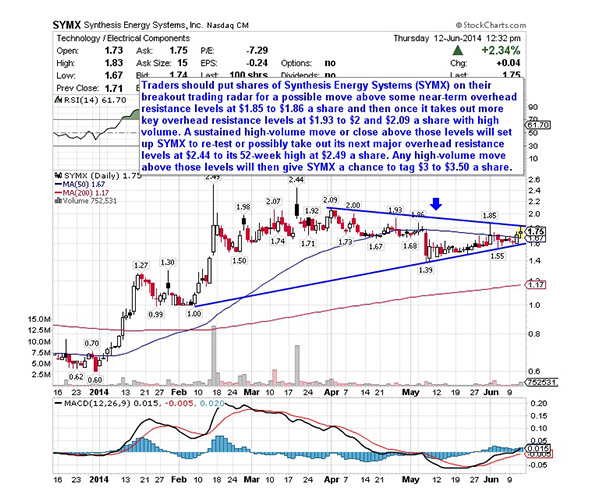
One under-$10 specialty chemicals player that's starting to move within range of triggering a major breakout trade is Synthesis Energy Systems (SYMX), which provides various proprietary gasification technology systems and solutions to the energy and chemical industries worldwide. This stock is off to a red hot start so far in 2014, with shares up a whopping 191%.

If you glance at the chart for Synthesis Energy Systems, you'll see that this stock has been uptrending over the last month and change, with shares moving higher from its low of $1.39 to its recent high of $1.85 a share. During that uptrend, shares of SYMX have been making mostly higher lows and higher highs, which is bullish technical price action. That move has started to push shares of SYMX within range of triggering a major breakout trade above some key near-term overhead resistance levels.

Traders should now look for long-biased trades in SYMX if it manages to break out above some near-term overhead resistance levels at $1.85 to $1.86 a share and then once it takes out more key overhead resistance levels at $1.93 to $2 and $2.09 a share with high volume. Look for a sustained move or close above those levels with volume that hits near or above its three-month average action of 594,782 shares. If that breakout gets underway soon, then SYMX will set up to re-test or possibly take out its next major overhead resistance levels at $2.44 to its 52-week high at $2.49 a share. Any high-volume move above those levels will then give SYMX a chance to tag $3 to $3.50 a share.

Traders can look to buy SYMX off weakness to anticipate that breakout and simply use a stop that sits right below some key near-term support levels at $1.60 to $1.55 a share. One can also buy SYMX off strength once it starts to clear those breakout levels with volume and then simply use a stop that sits a comfortable percentage from your entry point.

Endocyte
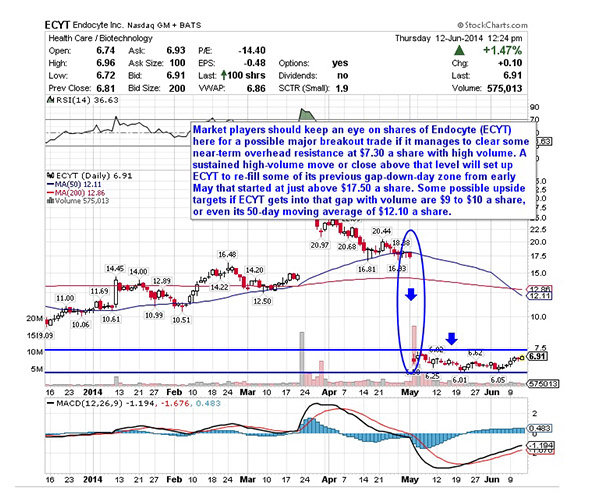
An under-$10 biopharmaceutical player that's starting to trend within range of triggering a big breakout trade is Endocyte (ECYT), which develops targeted therapies for the treatment of cancer and inflammatory diseases in the U.S. This stock is off to a nasty start in 2014, with shares down sharply by 35%.

If you take a look at the chart for Endocyte, you'll see that this stock has been trending sideways and consolidating for the last month and change, with shares moving between $6.01 on the downside and right around $7.30 on the upside. This consolidation pattern is coming after shares of ECYT gapped down sharply in May from over $17.50 to $6.50 a share with heavy downside volume. Shares of ECYT are now starting to trend higher off its recent low of $6.05 and it's quickly moving within range of triggering a major breakout trade above the upper-end of its recent sideways trading chart pattern.

Market players should now look for long-biased trades in ECYT if it manages to break out above some near-term overhead resistance at $7.30 a share with high volume. Look for a sustained move or close above that level with volume that registers near or above its three-month average action of 1.90 million shares. If that breakout materializes soon, then ECYT will set up to re-fill some of its previous gap-down-day zone from early May that started at just above $17.50 a share. Some possible upside targets if ECYT gets into that gap with volume are $9 to $10 a share, or even its 50-day moving average of $12.10 a share.

Traders can look to buy ECYT off weakness to anticipate that breakout and simply use a stop that sits right below its recent 52-week low of $6.01 a share. One can also buy ECYT off strength once it starts to take out $7.30 a share with volume and then simply use a stop that sits a comfortable percentage from your entry point.

BG Medicine​

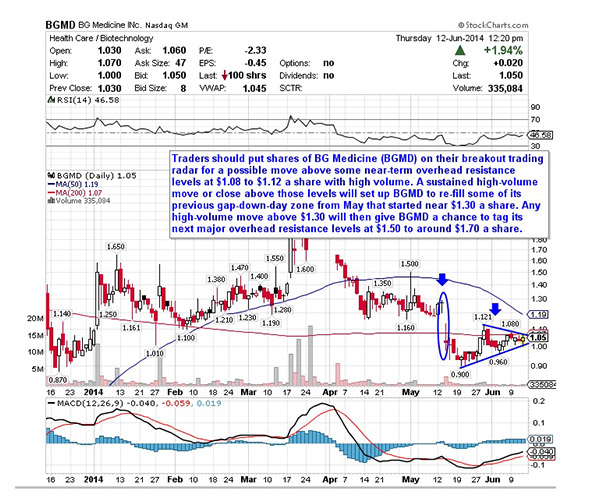
Another stock that's starting to move within range of triggering a big breakout trade is BG Medicine (BGMD), which develops and commercializes novel cardiovascular diagnostic tests to address unmet medical needs in the U.S. This stock has been pushed lower by the sellers over the last three months, with shares down sharply by 20%.

If you take a glance at the chart for BG Medicine, you'll notice that this stock has been uptrending a bit for the last month, with shares moving higher from its low of 90 cents per share to its recent high of $1.12 a share. During that uptrend, shares of BGMD have been making mostly higher lows and higher highs, which is bullish technical price action. That move has now pushed shares of BGMD within range of triggering a big breakout trade above some key near-term overhead resistance levels.

Traders should now look for long-biased trades in BGMD if it manages to break out above some near-term overhead resistance levels at $1.08 to $1.12 a share with high volume. Look for a sustained move or close above those levels with volume that hits near or above its three-month average action of 1.56 million shares. If that breakout gets started soon, then BGMD will set up to re-fill some of its previous gap-down-day zone from May that started near $1.30 a share. Any high-volume move above $1.30 will then give BGMD a chance to tag its next major overhead resistance levels at $1.50 to around $1.70 a share.

Traders can look to buy BGMD off weakness to anticipate that breakout and simply use a stop that sits right below some key near-term support levels at 96 cents to 90 cents per share. One can also buy BGMD off strength once it starts to clear those breakout levels with volume and then simply use a stop that sits a comfortable percentage from your entry point.

Exelixis​

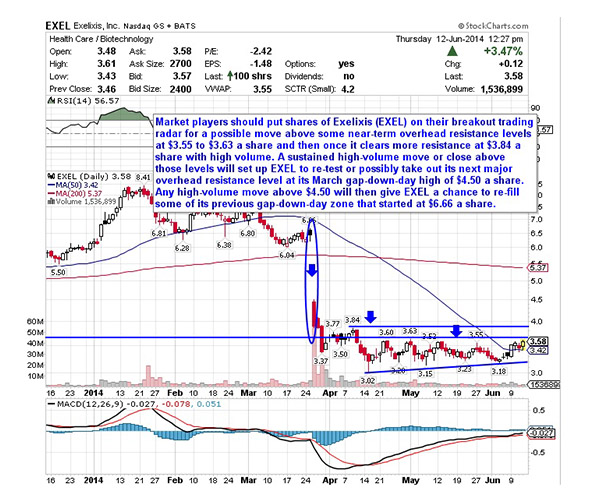
Another under-$10 biotechnology player that's starting to trend within range of triggering a near-term breakout trade is Exelixis (EXEL), which develops small molecule therapies for the treatment of cancer in the U.S. This stock has been crushed by the bears so far in 2014, with shares down sharply by 41%.

If you look at the chart for Exelixis, you'll notice that EXEL has been trending sideways and consolidating for the last two months and change, with shares moving between $3.02 on the downside and $3.84 on the upside. Shares of EXEL are starting to spike higher today right off its 50-day moving average of $3.42 a share. That spike is quickly pushing shares of EXEL within range of triggering a near-term breakout trade above some key overhead resistance levels.

Market players should now look for long-biased trades in EXEL if it manages to break out above some near-term overhead resistance levels at $3.55 to $3.63 a share and then once it clears more resistance at $3.84 a share with high volume. Look for a sustained move or close above those levels with volume that hits near or above its three-month average action of 4.85 million shares. If that breakout kicks off soon, then EXEL will set up to re-test or possibly take out its next major overhead resistance level at its March gap-down-day high of $4.50 a share. Any high-volume move above $4.50 will then give EXEL a chance to re-fill some of its previous gap-down-day zone that started at $6.66 a share.

Traders can look to buy EXEL off weakness to anticipate that breakout and simply use a stop that sits right below some key near-term support levels at $3.18 to $3.02 a share. One can also buy EXEL off strength once it starts to move above those breakout levels with volume and then simply use a stop that sits a comfortable percentage from your entry point.

Northwest Biotherapeitics
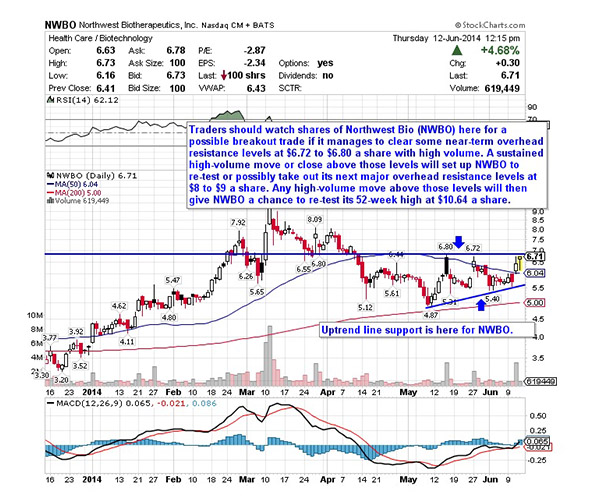
One final under-$10 biopharmaceuticals player that looks ready to trigger a near-term breakout trade is Northwest Biotherapeitics (NWBO), which discovers and develops immunotherapy products to treat cancers in the U.S. and internationally. This stock has been off to a monster start so far in 2014, with shares up sharply by 78%.

If you take a glance at the chart for Northwest Biotherapeutics, you'll notice that this stock has been uptrending for the last month, with shares moving higher from its low of $4.87 to its recent high of $6.80 a share. During that uptrend, shares of NWBO have been making mostly higher lows and higher highs, which is bullish technical price action. That uptrend started right off NWBO's 200-day moving average and the stock has now started to spike higher today right off its 50-day moving average. This move is starting to push shares of NWBO within range of triggering a near-term breakout trade above some key overhead resistance levels.

Traders should now look for long-biased trades in NWBO if it manages to break out above some near-term overhead resistance levels at $6.72 to $6.80 a share with high volume. Look for a sustained move or close above those levels with volume that hits near or above its three-month average action of 991,491 shares. If that breakout triggers soon, then NWBO will set up re-test or possibly take out its next major overhead resistance levels at $8 to $9 a share. Any high-volume move above those levels will then give NWBO a chance to re-test its 52-week high at $10.64 a share.

Traders can look to buy NWBO off weakness to anticipate that breakout and simply use a stop that sits right below its 50-day moving average of $6.04 a share or around more support at $5.50 a share. One can also buy NWBO off strength once it starts to trade above those breakout levels with volume and then simply use a stop that sits a comfortable percentage from your entry point.

To see more hot under-$10 equities, check out the Stocks Under $10 Setting Up to Explode portfolio on Stockpickr.

-- Written by Roberto Pedone in Delafield, Wis.


RELATED LINKS:


>>3 Huge Stocks Everyone Is Talking About >>5 Health Care Stocks to Trade for Gains in June >>4 Stocks Breaking Out on Big Volume


Follow Stockpickr on Twitter and become a fan on Facebook.

At the time of publication, author had no positions in stocks mentioned.

Roberto Pedone, based out of Delafield, Wis., is an independent trader who focuses on technical analysis for small- and large-cap stocks, options, futures, commodities and currencies. Roberto studied international business at the Milwaukee School of Engineering, and he spent a year overseas studying business in Lubeck, Germany. His work has appeared on financial outlets including CNBC.com and Forbes.com. You can follow Pedone on Twitter at www.twitter.com/zerosum24 or @zerosum24.


Saturday, March 14, 2015

Is Scripps Networks Interactive on Your Radar?

Scripps Networks Interactive (NYSE: SNI  ) looks stronger than ever after a great first quarter. 

While most cable networks experienced a dip in viewership largely because of the Olympics, Scripps' popular channels -- including HGTV, Food Network, and Travel Channel -- actually increased viewership numbers, especially in the key 25- to 54-year-old demographic advertisers covet.

This shows management's programming savvy as well as the staying power of its brands, all of which give Scripps tremendous pricing power when it comes to advertising rates and affiliate fees. But lots of sharks swim in the sea of cable television programming.

Stock Advisor analyst Sara Hov and Rule Breakers analyst Simon Erickson talk about what's ahead for Scripps, including the chance that this small-but-mighty company could get swallowed by a bigger fish.

Your cable company is scared, but you can get rich
You know cable's going away. But do you know how to profit? There's $2.2 trillion out there to be had. Currently, cable grabs a big piece of it. That won't last. And when cable falters, three companies are poised to benefit. Click here for their names. Hint: They're not Netflix, Google, and Apple. 


Wednesday, March 11, 2015

The Week Ahead: Another Scare Like 2010, 2011, and 2012?

The end of another rough trading week harkens back to the panic sell-offs that occurred in recent years and MoneyShow's Tom Aspray uses chart analysis to determine whether this sell-off will be followed by new bull market highs.

It was another rough week for the markets as the heavy selling came as the average investor was trying to digest the significance of the market rigging headline that I discussed last time. The selling hit panic levels on Thursday, but it is too early yet to conclude that the decline is already close to being over.

The technical picture last Wednesday allowed for two scenarios and, as of Friday, there is not enough evidence to be confident whether the large-cap Spyder Trust (SPY) and SPDR Dow Industrials (DIA) are going to join the Powershares QQQ Trust (QQQ) on the downside.

The plunge in the technology and biotechnology stocks is being tied to the perception that the economy is not strong enough to support the current high stock prices. This view is not really supported by the current numbers, as past market declines in this bull market have come in conjunction with much softer numbers than we are seeing now.

The current environment does remind me of the panic sell-offs that occurred in 2010, 2011, and 2012. I have circled these periods on the weekly close only chart of the S&P. For example, on August 27, 2010,  there was this Bloomberg headline "El-Erian Says `Alarming' Data Show U.S. Economy Slowing."

The S&P 500 had actually made its low in early July 2010, but had a secondary low at 1039, the day this article was published. Below the chart of the S&P 5000 is a chart of the S&P 500 Advance/Decline line which reveals that it had made a new high the prior April (point 1) . By February of 2011, the S&P 500 had risen to 1344.

chart

In the summer of 2011, there was the massive decline that began in late July that was followed by heavy selling in early August in reaction to the budget impasse and downgrade of US debt. By September, the fear of a double dip recession was being widely discussed. On September 7, a CNBC headline read  "US Economy Is Basically 'Still In Recession': Fed's Evans."

The S&P 500 dropped to a low of 1074 on October 4, before reversing to the upside. The A/D line had made a new high in early July (point 2). A week after the low, there was strong technical evidence that the lows were in place, leading to my article "Be Bold, Be Fearless.Buy the Dip." By April 2012, the S&P 500 was trading well above 1400.

The A/D line made a new high that April, but by the end of the month, it had moved into the corrective mode. By May, the concern was over the troubles in the Eurozone with this headline on May 27 from the telegraph "Lloyd's of London preparing for euro collapse."

The S&P 500, which had traded as high as 1422 at the start of April, dropped to a low of 1266 on June 4, just five days after the article was published. The Euro dropped to a low of 1.2042 the next month and has been moving higher ever since. At the June lows, there were also strong technical signs that the correction was over, as I noted on June 6.

In the middle of September 2012, the A/D line made another new high (point 4), which is hard to tell from the chart. By the end of October, concerns over the economy and the outcome of the presidential election resulted in significant selling.

chart

The S&P 500 had reached a high of 1474 in September and, by the time this headline appeared on November 7, it was down to 1394. The S&P bottomed on November 16 at 1343 and then rallied to close the year at 1426, despite a year end decline in reaction to the "fiscal cliff."

As the S&P 500 chart indicates, the A/D line has made a series of higher highs in 2013 and early 2014 (line 5) as its most recent high was on April 4. It does not yet show a new downtrend, which would be consistent with a deeper correction in the S&P 500 and NYSE Composite.

chart

The bond market does seem to be a bit more worried as the yield on the 10 - Year T-Note looks ready to close at 2.63% as it has dropped below the lows of the past six weeks. The next strong support is in the 2.44-2.50% area and the weekly starc- band. The MACD shows no sign yet of bottoming as it is still in a downtrend, line c.

NEXT PAGE: What to Watch

Page 1 | Page 2 | Page 3 | Page 4 | Next Page

Tuesday, March 10, 2015

Dish and DirecTV surge on merger reports

dish network directtv

The government blocked a proposed merger of Dish and DirecTV back in 2002.

NEW YORK (CNNMoney) Shares of Dish Network and DirecTV soared higher Wednesday following reports that the two satellite television companies are considering a merger.

Bloomberg broke the news, reporting that Dish chairman Charlie Ergen recently reached out to DirecTV CEO Mike White. Dish (DISH, Fortune 500) shares surged 9% following the report, while DirecTV (DTV, Fortune 500) rose 7.5%.

Dish and DirecTV declined to comment.

The news follows Comcast's announcement last month that it had agreed to buy Time Warner Cable (TWC, Fortune 500) for $45 billion in a deal that would combine the two biggest cable companies in the United States. The firms will likely face antitrust scrutiny from regulators, who could block the deal.

Bloomberg said Ergen approached White and Time Warner Cable in response to the Comcast (CMCSA, Fortune 500) deal. White, the news service added, "is reluctant to push forward with formal talks out of concern regulators may block the deal because the two companies directly compete with each other."

There's precedent for that concern -- the government blocked a proposed merger of the two companies back in 2002. To top of page

Sunday, March 8, 2015

Stocks: Where to make money in 2014

stocks outlook NEW YORK (Money Magazine) In Money magazine's Make More in 2014, you'll find next year's economic outlook, where to find opportunities in stocks and bonds, the best moves for homebuyers, sellers and owners, and strategies for boosting your career. This installment: Tips on investing in stocks next year.

While housing and jobs improve as the economy gets going, equities move in anticipation of better times to come. For proof, see the double-digit gains the S&P 500 posted this year.

The "strengthening economy" theme, though, is already played out. Standard & Poor's says that U.S. shares are likely to keep climbing, but only by a modest 7% or so by late 2014.

Why? Valuations "are definitely not compelling," says Sam Stovall, chief equity strategist for S&P Capital IQ. The price/earnings ratio for equities jumped from a not-exactly-cheap 19 in January to 22, based on five years of average profits.

A rising P/E reflects higher expectations. Investors are paying more for stocks because they think earnings will grow even faster. To make money in this market, your stocks have to deliver profits. Or you must go with cheaper shares that have a greater margin for error.

THE STRATEGY: Add a foreign accent

In an increasingly expensive market, look for bargains. U.S. and international equities used to trade at similar levels, but today overseas stocks are about 20% cheaper based on five-year average profits. Says Paul Zemsky, chief investment officer for multi-asset strategies at ING Investment Management: "Europe is just beginning its recovery and is a lot less expensive than the U.S."

YOUR BEST MOVE

Boost your bet on Europe. Zemsky recommends increasing your foreign-equity stake by five to 10 percentage points. So if you normally keep 25% of your stock portfolio abroad, sell some of! your domestic holdings, which have had a remarkable five-year run, and raise your foreign weighting up to 35%.

You can use MONEY 70 pick Dodge & Cox International (DODFX) (Avg. P/E: 14.3), with more than 75% of its assets in Europe. For an even more targeted approach, go with Vanguard FTSE Europe ETF (VGK) (Avg. P/E: 14.2).

THE STRATEGY: Focus on revenue

As the economy accelerates, trim your exposure to defensive areas such as consumer stocks and utilities. Stick instead with sectors likely to see rising global demand, says R.W. Baird strategist William Delwiche.

YOUR BEST MOVES

Think industrials. Greg Thomas -- whose ThomasPartners dividend growth strategy, available through Schwab, beat the S&P 500 over the past decade -- favors global blue chips such as United Technologies (UTX, Fortune 500) (Avg. P/E: 16.5). Top holdings of Industrial Select SPDR ETF (XLI) (Avg. P/E: 17.5) include GE (GE, Fortune 500) and UTX.

Think technology. Business spending is expected to pick up in 2014, says Russell Investments chief economist Mike Dueker. And the productivity-enhancing tech sector will benefit. Jeff Layman, chief investment officer at BKD Wealth Advisors, favors firms such as Cisco Systems (CSCO, Fortune 500) (Avg. P/E: 11.0) that provide infrastructure parts and services, not consumer companies. Cisco, Qualcomm, and Intel are among the top stocks in the Technology Select SPDR ETF (XLK) (Avg. P/E: 15.8).

Make More in 2014

The economy: What's ahead in 2014 Bonds: Tweak your mix in 2014 Real estate: Look for value in in 2014 Jobs: Boost your career in 2014 How 2013 shaped up To top of page

Wednesday, March 4, 2015

PBR Stock Update – Why Petrobras Is Plummeting

Add pricing issues to long-suffering Petrobras (PBR) shareholders’ pile of worries. Shares of PBR stock are falling hard today, currently down 10% at press time.

pbr-stock-petrobasWhy the mass selling of PBR stock? Because of transparency issues for Petrobras on the back of a recent announcement of an 8% price hike on diesel fuel and a 4% hike on gasoline.

Including today’s tumble, shares of Petrobras stock are sitting about 27% in the red year-to-date.

PBR Stock Investors Worried About Transparency

PBR stock investors aren’t likely worried as much about the price hike itself … but the fact that Petrobras may not be doing enough to raise profits and stop the bleeding with respect to its earnings.

PBR has suffered more than $12.8 billion in losses over the last two years as prices for what it sells have been outpaced by the costs associated with producing that oil and refined products. Petrobras reported a $3.8 billion loss in its downstream/refining segment during the quarter because of fuel price subsidies in place. PBR is very much controlled by the Brazilian government, which has pressured Petrobras to keep prices for its gasoline and diesel at lows in order to rein in inflation.

After last quarter’s continued earnings losses, Petrobras promised to unveil a new pricing strategy to help turn the tide and boost profitability at the firm. But what the market got from PBR wasn't so great.

The issue for PBR stock shareholders is that the increase will apply only to the amount distributors pay before tax. Analysts estimate this will really only result in a 3% bump for PBR. Secondly, according to the official press release touting the Petrobras price increase, “the parameters of the pricing method will be kept strictly in-house for commercial reasons.”

The fact that no one really knows how or when Petrobras will calculate the price increases has truly spooked PBR stock shareholders. And several analysts have cited concerns about how to model the financial condition of PBR stock over the next coming quarters. That’s a huge concern.

Publicly traded companies thrive on trust. But PBR stock has become a “guessing game” for investors and analysts, with some now anticipating that the hikes won't actually happen at all under the adopted program do to that statement.

President Dilma Rousseff was reluctant to sign off on the new fuel price policy this year and Brazil's government could be just pulling the wool over investor's eyes. 2014 is an election year in Brazil. And with PBR still very much a tool of the people, the price gains could be muted.

Given the issues, analysts at Credit Suisse (CS) moved PBR stock into the sell category. Other analysts followed suit with downgrades and sell recommendations on Petrobras stock. That prompted mass selling from investors, with shares of PBR stock trading at twice its average volume.

Skip PBR Stock

For investors, the recent lack of transparency at Petrobras highlights the issues with the state-owned companies that are used as populist tools. PBR continues to suffer, while other independent oil stocks flourish. Given that that some analysts have pegged the price increases as smoke and mirrors or not even enough, investors may want to avoid PBR stock in favor of other producers.

The issues at Petrobras continue to mount and that doesn't make PBR stock a great portfolio play.

As of this writing, Aaron Levitt did not hold a position in any of the aforementioned securities.