Saturday, February 28, 2015

Rogers Beats BCE In NHL Rights Bidding Battle: Corporate Canada

Nadir Mohamed has been overshadowed for much of his tenure as head of Rogers Communications Inc. (RCI/B) by the dealmaking of his main rival, George Cope at BCE Inc. (BCE)

Just six days before he retires, Mohamed has struck back, outbidding Cope with a C$5.2 billion ($4.9 billion) agreement for broadcast and digital rights to National Hockey League games in Canada over the next 12 years.

Mohamed, 57, told reporters yesterday in Toronto that the deal, the biggest in his five years as chief executive officer of Canada's largest wireless provider, will provide fresh revenue from sports content and be immediately accretive to earnings. It also deprives BCE's TSN network of national rights to Canada's favorite sport.

"It's a spectacular deal for Rogers," said Lee Berke, president of LHB Sports, Entertainment and Media, whose sports consulting firm is based in Scarsdale, New York. "Their competition from a telco standpoint, from a network standpoint - - TSN -- they've eliminated them. It's total control."

Rogers is betting that the broadcast rights, starting in the 2014-2015 hockey season, will provide additional revenue from advertisers and consumers as wireless users increasingly watch sports and follow their favorite teams on smartphones and tablets. In the U.S., sports broadcaster ESPN Inc. said 36 percent of its digital users in October only accessed content from such handheld devices.

Buying Spree

NHL hockey nets about C$100 million in advertising revenue for CBC in a year, a third of its total, Wade Rowland, a professor at York University in Toronto and author of a book on the public broadcaster's budget, said today.

Montreal-based BCE has followed a similar strategy, investing more than C$7 billion to add assets including TSN, which it bought along with the CTV network for C$1.3 billion plus debt in 2011. Cope, who leads Canada's No. 2 wireless operator, also added content by purchasing Astral Media Inc. for C$3.2 billion in July.

Mohamed had been less active on the deals front until he teamed up with BCE in 2011 to buy a majority stake in Maple Leaf Sports & Entertainment Ltd. That deal, which closed in August, 2012, gave Rogers joint ownership of the Toronto Maple Leafs, the NHL's most valuable team, as well as the Toronto Raptors of the National Basketball Association.

Bell Outbid

Rogers and BCE each paid C$533 million for a 37.5 percent stake. Rogers then agreed to buy Score Media Inc. that same month for C$167 million.

The MLSE deal has probably already paid off for the two companies, said Richard Peddie, former CEO of Maple Leaf Sports.

"Pro sports broadcast rights continue to escalate," he said in an e-mail. "Proves again why Bell & Rogers got a great deal buying MLSE."

Rogers slipped 1.2 percent to C$46.23 at 4 p.m. in Toronto, the most in more than a month. BCE fell less than 1 percent to C$46.54. Rogers has climbed 2.4 percent this year, compared with BCE's 9.2 percent gain.

Bell, as the main BCE brand name is known, said yesterday it was outbid by Rogers for the NHL rights. NHL Commissioner Gary Bettman declined to comment yesterday on the competing bids that came up short.

Appropriate Bid

"We submitted a bid we believed was valuable for the NHL and appropriate for our business," Scott Henderson, a spokesman for Bell Media, said in an e-mail yesterday. "We're committed to TSN remaining Canada's sports leader."

Bettman, speaking alongside Mohamed yesterday, said Rogers's ability to clinch the rights wasn't just about price. "The Rogers people should be commended for their aggressiveness and strategy," he said.

Rogers's first annual payment to the league will be about C$300 million, climbing to the mid-C$500 million range in the final year of the deal. The Toronto-based company said that it reached separate sublicensing agreements with the Canadian Broadcasting Corp. to continue to broadcast its traditional "Hockey Night in Canada" program on Saturdays, and with Quebecor Media Inc.'s TVA for all French-language national broadcasting rights.

Rogers, which already owns Sportsnet cable television, said the cost of the payments to the NHL will be partly defrayed by the CBC and TVA sublicensing deals. Mohamed said that the agreement will be "accretive from the get-go" to Rogers' profitability. Rogers had net income before one time items of C$1.73 billion last year, on revenue of C$12.5 billion.

Earnings Impact

Keith Pelley, the head of Rogers' media unit who joined from CTV in 2010, told reporters that the deal is "self-financing" by creating fresh revenue that will cover the annual payments.

Advertising revenue will probably make up some but not all of those costs, said Peddie, the former head of Maple Leaf Sports. Rogers can make up the difference with higher cable subscriber fees, and by offering new premium hockey packages for hardcore fans, he said.

Still, Rogers is paying more than double what U.S. broadcasters paid the league for local rights. The NHL's games are broadcast in the U.S. under a 10-year contract signed with Comcast Corp.'s NBC and Versus networks in 2011. That agreement was worth $2 billion, people with knowledge of the transaction said at the time.

'Awful Lot'

"Five billion is an awful lot," said Ian Nakamoto, director of research with MacDougall MacDougall & MacTier Inc. in Toronto. "I'm not sure if it adds that much warmth and comfort to me." Nakamoto's firm manages about C$4.7 billion, including Bell and Rogers shares.

"This NHL deal adds content to their assets, but I don't see it as a big deal," he said.

Bell and TSN will still broadcast 10 Maple Leafs games next season and 26 games starting in 2015 and has partnerships with teams in Montreal, Ottawa and Winnipeg, along with Hockey Canada and the World Junior Championships, said Bell's Scott Henderson. In addition to its stake in the Leafs, BCE also has a stake in the Montreal Canadiens that preserve its regional broadcasting rights for those teams.

Guy Laurence, who used to run Vodafone Group Plc (VOD)'s U.K. business, replaces Mohamed on Dec. 2, capping his tenure as CEO with a flourish.

"It's remarkable and a testament to Rogers how quickly this came together," said Bettman.

Friday, February 27, 2015

Earnings Growth is Up, but Don't Get too Excited

Even though companies have exceeded projections for the third quarter, it's not the time to get overly excited about the rest of 2013 or 2014, writes MoneyShow's Jim Jubak, also of Jubak's Picks.

It wasn't much of a hurdle, but it looks like companies jumped it in the third quarter.

With 90% of the Standard & Poor's 500 (SPX) reporting, earnings are up 3.7% year over year for the quarter, according to FactSet. Taking into account estimated earnings at companies that haven't yet reported, earnings are projected to show 3.5% growth in the quarter.

Going into the third quarter, companies were projected by Wall Street analysts to show 1% earnings growth. Among companies that have reported, 69% have exceeded consensus earnings estimates. That's at the high end of the average historical range. Earnings grew by 2.6% year over year in the second quarter.

Third quarter revenues are up 2.9% with 52% of companies beating analyst projections on revenue. Sales grew 1.7% year over year in the second quarter.

The end of the third quarter shifts attention to projections for the fourth quarter. Estimates now call for fourth quarter earnings growth of 7% on sales growth of 0.6%. Estimates almost always come down as earnings reporting season gets closer, so I'd expect fourth quarter estimates to decline as we move through January and February and into March. Three months ago, projections for the fourth quarter called for 10% earnings growth.

Projections now see earnings growth of 5% for the full 2013 year on 1.9% sales growth. If those projections were accurate, 2013 would turn out to be slightly better than the 4% earnings growth in 2012.

Projections for 2014 are now looking at 11% earnings growth and 4.3% revenue growth.

If 2014 earnings come in on those projections, the S&P 500 trades at 14.8 times 2014 earnings.

The likelihood of 2014 projections being too optimistic, however, is extremely high.

Full disclosure: I don't own shares of any of the companies mentioned in this post in my personal portfolio. When in 2010 I started the mutual fund I manage, Jubak Global Equity Fund, I liquidated all my individual stock holdings and put the money into the fund. The fund did not own shares of any stock mentioned in this post as of the end of June. For a full list of the stocks in the fund as of the end of June see the fund's portfolio here.

Monday, February 16, 2015

McDonald’s slammed over Ronald McDonald House g…

McDonald's is basically a minor financial supporter of its own Ronald McDonald House Charities and should immediately stop linking long-time spokes-character Ronald McDonald with it, says a consumer advocacy group in a scathing report out today.

The 30-page report, funded by Corporate Accountability International and The Small Planet Fund, charges that McDonald's is mostly using the charity as a branding device for its food sales because the corporation, itself, contributes so little to the charity. While McDonald's reaps 100% of the "branded benefit" from the charity, it only contributes about 20% of the money, the report charges.

"McDonald's giving does not match its rhetoric," says Michele Simon, a public health lawyer who authored the report dubbed "Clowning Around with Charity: How McDonald's Exploits Philanthropy and Targets Children."

The report does not accuse McDonald's of doing anything illegal with its namesake charity. The issues it highlights are ethical. Among the report's recommendations: McDonald's should rename Ronald McDonald House Charities and junk Ronald McDonald as a spokesman.

McDonald's has no such plans. And McDonald's officials blast the report's findings.

"McDonald's categorically rejects this self-serving and biased document and stands proud of the significant financial support and volunteer hours we have and will continue to provide to Ronald McDonald House Charities and other charities worldwide," says Bridget Coffing, senior vice president of corporate relations, in a statement.

By linking Ronald McDonald, in particular, to the charity, "McDonald's gains an emotionally-loaded marketing vehicle while shielding itself from critics," the report concludes.

Simon says that McDonald's contributes between $5.3 and $10 million to its name-sake, global charity, according to publicly available data that the advocacy group reviewed.

Even then, the report is extra careful not to criticize what the charity, itself, does -- which is p! roviding housing for parents of children who are hospitalized with serious illnesses. The report calls the charity "vitally important."

Globally, Ronald McDonald House Charities gets less than one-quarter of its revenue from McDonald', the report says. And at the local level, the regional chapters and local Ronald McDonald Houses often get as little as one-tenth of their revenue from McDonald's.

Even McDonald's customers, the report charges, contribute as much as 1.5 times more to the charity than does McDonald's itself.

"Most people think that McDonald's funds Ronald McDonald House Charities 100%," says Simon. "This is a disconnect between what most people think and reality."

On its web site, for example, The Los Angeles Ronald McDonald House, which is one of the nation's largest with 75 rooms, notes, "although our House shares a brand name with McDonald's Corporation, less than 10% of our annual $2 million budget comes as a result of financial contributions from the company's local owner / operators."

But McDonald's executives scoff at the report.

"This 'report' is shameful and misleading. We hesitate to even dignify it with a comment, but that would be a disservice to the McDonald's employees, franchisees, suppliers and customers who have partnered tirelessly to support the tremendous work of Ronald McDonald House Charities," says Coffing, in her statement. "This is a thinly-veiled attack on our brand at the expense of the millions of families and organizations who have benefitted from Ronald McDonald House Charities."


Friday, February 13, 2015

Higher Rates Can't Hinder Housing's Recovery

If the recent rise in home sales is yet another indication of the real estate market returning to normal, now may be the time to consider investing in homebuilders.

In July, home sales rose to their highest level since November 2009, when a federal tax credit spurred a surge of homebuying. This July's seasonally adjusted sales rate was up 17% from July 2012, and the 5.39 million homes sold beat economists' estimates of 5.15 million. In a sign that demand for homes is picking up, median home prices have risen to $213,500, up 14% from July 2012. That's the biggest year-over-year gain since 2005.

Will rising rates scare buyers away?
Market experts are predicting that sales could slow due to rising rates on mortgages, but prices should remain high if the inventory of homes remains tight . USA TODAY reports that interest rates have risen a full percentage point since May, meaning that a median-price homebuyer with a 20% down payment can expect to pay about $100 more a month.

The participants in the housing market are also changing. According to ABC News, investors now make up 16% of home purchasers, down from February's 22%. The data also noted that first-time homebuyers haven't joined in, making up only 29% of July sales. A healthy real estate market usually has about a 40% participation rate from first-time buyers .

While stock prices for homebuilders have fallen in recent months due to rising mortgage rates, the sector may provide buying opportunities for patient investors who believe that housing demand should return to normal levels in the next few quarters. After all, even those higher rates remain historically low. Let's examine how some of the top names in U.S. homebuilding are benefiting from stronger housing demand despite rising mortgage rates.

Lennar reports demand in its markets outpacing supply
Lennar's (NYSE: LEN  ) second-quarter net earnings for the period ended May 31 were $137.4 million, or $0.61 per diluted share. Earnings were hurt by the partial reversal of a deferred tax asset worth $41.3 million, or $0.18 per diluted share. Note that a deferred tax asset is used to decrease the company's tax expense in future periods. Earnings for the second quarter dropped about 70% from $452.7 million, or $2.06 per diluted shares in the previous year . 

CEO Stuart Miller remains confident in a solid housing recovery. Demand in all of Lennar's markets is outpacing supply as it is being squeezed by a limited availability of land and fewer competitors. Despite the rate increases, Miller believes homes are still affordable and has noted little impact on unit sales or pricing .

Toll Brothers has rising sales volume and unit prices
For the third quarter ended on July 31, Toll Brothers' (NYSE: TOL  ) net income was $46.6 million, or $0.26 per share. The latest income figures were down 24% from last year's third-quarter results of $61.6 million, or $0.36 per share. The company's total quarterly revenues were $689.2 million, up 24% over last year, and homebuilding deliveries were 1,059 units, up 10% compared to the same period last year .

According to CEO Douglas C. Yearley, both sales volume and prices increased during the quarter; this pattern is consistent with recent quarters. He confirmed that he believes the housing recovery is in its early stages. The company is committed to growth and increased its land position during the quarter. Toll Brothers' community count was 225 at the end of the third quarter, and is projected to grow 10% to 15% by the end of fiscal 2014 .

PulteGroup has high growth expectations
PulteGroup (NYSE: PHM  ) reported $36 million, or $0.09 per share, of net income for its second quarter ended June 30. Net income included charges for several events that took place in the quarter. In the prior year's quarter, the company reported net income of $42 million, or $0.11 per share. CEO Richard J. Dugas Jr. believes the housing market is on track to a long-term recovery. He finds that consumers see good value in the market, despite a limited supply of housing inventory, rising prices, and higher interest rates.

Adjusted home sales gross margin for the third quarter was 23.9%, an increase of 360 basis points. Net new orders for the second quarter were 4,885 homes, down 12% from prior year. On a dollar basis, the value was $1.5 billion, a decrease of 5% from 2012 .

My foolish conclusion
The average PEG ratios for Toll Brothers -- 0.73 -- and PulteGroup -- 0.51-- are much less than the industry average of 1.92. Sales of Toll Brothers' homes may also be less susceptible to rising mortgage rates since the company caters to a more affluent consumer. Both Toll Brothers and PulteGroup have high five-year growth rate projections of about 54% and 30%, as compared to an industry average growth rate of approximately 20%. 

Based on these numbers, and increasing evidence of a strengthening market, Toll Brothers and PulteGroup may offer a good value for investors looking to invest in the early stages of the housing recovery. 

Looking for other impressive values?
Solid companies selling at depressed prices have consistently helped generations of the world's most successful investors preserve capital, minimize risk, and achieve long-term, market-trampling returns. For one such company, read our free report: "The One REMARKABLE Stock to Own Now." Just click here to get started.


Case-Shiller: Home Price Recovery Already in Jeopardy

The S&P/Case-Shiller home price index for June posted another month of solid gains, but not on the same pace as the record-setting rise in May. The 20-city composite rose 12.1% year-over-year, just a tick below the consensus estimate for a gain of 12.2%, which also happened to be the record May rate. The 10-city index rose 11.9% year-over-year in June.

The index tracks prices on a three-month rolling average. The June figures represent the three-month average of April, May and June prices.

On a month-over-month basis, June prices were up 2.2% on the 10-city composite index and 2.2% on the 20-city composite. House prices in Dallas and Denver set new record highs in again in June. All 20 cities in the index posted gains on a monthly and annual basis.

The chairman of the S&P index committee said:

Overall, the report shows that housing prices are rising but the pace may be slowing. Thirteen out of twenty cities saw their returns weaken from May to June. As we are in the middle of a seasonal buying period, we should expect to see the most gains. With interest rates rising to almost 4.6%, home buyers may be discouraged and sharp increases may be dampened.

Among equities tied to home building, none is reacting particularly well to today's report. The uncertainty about a U.S. response to Syria is the likely reason, because this report is pretty strong.

Home Depot Inc. (NYSE: HD) shares are down 0.0% in premarket trading Tuesday to $74.75, even after a big quarter and company management's boost to guidance. The stock's 52-week range is $56.20 to $891.56.

Lowe's Companies Inc. (NYSE: LOW) posted even better results than Home Depot last quarter, but shares are down 1.2% this morning, at $46.41 in a 52-week range of $27.66 to $47.51. The home improvement business should be able to fight off the effects of rising interest rates better than the new home builders.

Shares of Toll Brothers Inc. (NYSE: TOL) are down nearly 2% shortly after the open, and KB Home (NYSE: KBH) is down about 1.6%. Rising interest rates are not helping the home builders, but rate increases are slowing.

Toll Brothers' CEO said in last week's earnings release:

Sales volumes and pricing power both increased this quarter from one year ago, a pattern consistent with recent quarters. We believe the recovery is real and we are in the early stages of the rebound.

The recovery may be real, but it is stalling a bit today. The iShares Dow Jones U.S. Home Construction (NYSEMKT: ITB) is down 1.3%, at $20.92 in a 52-week range of $17.67 to $26.21.

The housing market is really in better shape than the share prices look today. But threats of military action trump a lot of things.

Tuesday, February 10, 2015

Can Questcor Prevail in Pulmonary?

Acthar gel boasts 19 different indications for which the Food and Drug Administration has granted approval. Questcor (NASDAQ: QCOR  ) now has its sights on profiting from one of those that it hasn't targeted previously. The company today announced plans to kick off a pilot commercialization effort for symptomatic sarcoidosis, a rare disease that most often affects the lungs.

Starting small
Questcor says that it will hire between five and 10 sales representatives to call on pulmonologists within the next couple of months or so. These reps will be trained and prepared to deliver the company's message on the benefits of Acthar in treating respiratory manifestations of symptomatic sarcoidosis.

The company expects those sales reps to hit the pavement in the fourth quarter, knocking on the doors of pulmonologists. Can only a handful of reps even make a dent in building up sales for Acthar? Not really, but that's not the most important goal -- at least at the beginning.

As Questcor COO Steve Cartt stated, the company expects to "gain valuable information" from the initial effort. This information will then be used to determine the best way to move forward with broader commercialization efforts.

Looking ahead
There's no guarantee that the effort to sell Acthar as a treatment for symptomatic sarcoidosis will be successful. Questcor readily admits that. However, the company does have a couple of things in its favor.

Currently, the only approved treatments for the disease are steroids -- and Acthar. Questcor needs to convince pulmonologists that Acthar is the superior alternative. The company is evaluating the possibility of moving forward with clinical studies that could bolster its case.

The other advantage for Questcor is its track record. While symptomatic sarcoidosis is a new area for the company, expanding Acthar in a smart way isn't new.

Questcor most recently took a similar approach for rheumatology. The company started small, as it's planning to do with the new targeted indication. It learned as it went forward and refined sales strategies. As a result, Questcor now says that it is seeing higher than expected prescription volumes for Acthar in treating rheumatoid arthritis and is hearing positive feedback from physicians.

Can Questcor repeat its success and prevail in the pulmonary market? I wouldn't discount the company's chances. Winning over pulmonologists isn't a sure thing, but the way Questcor handles the process makes sense. And if things don't work out, there are plenty more of those 19 approved indications to target next.

Questcor's strategy of doing more with what it's got actually isn't a bad idea for individuals. Take Social Security, for example. It plays a key role in your financial security even if you're years away from receiving benefits. In our brand-new free report, "Make Social Security Work Harder For You," our retirement experts give their insight on making the key decisions that will help ensure a more comfortable retirement for you and your family. Click here to get your copy today.

Monday, February 9, 2015

Why the Street Should Love US Physical Therapy's Earnings

Although business headlines still tout earnings numbers, many investors have moved past net earnings as a measure of a company's economic output. That's because earnings are very often less trustworthy than cash flow, since earnings are more open to manipulation based on dubious judgment calls.

Earnings' unreliability is one of the reasons Foolish investors often flip straight past the income statement to check the cash flow statement. In general, by taking a close look at the cash moving in and out of the business, you can better understand whether the last batch of earnings brought money into the company, or merely disguised a cash gusher with a pretty headline.

Calling all cash flows
When you are trying to buy the market's best stocks, it's worth checking up on your companies' free cash flow once a quarter or so, to see whether it bears any relationship to the net income in the headlines. That's what we do with this series. Today, we're checking in on US Physical Therapy (NYSE: USPH  ) , whose recent revenue and earnings are plotted below.

Source: S&P Capital IQ. Data is current as of last fully reported fiscal quarter. Dollar values in millions. FCF = free cash flow. FY = fiscal year. TTM = trailing 12 months.

Over the past 12 months, US Physical Therapy generated $34.3 million cash while it booked net income of $17.2 million. That means it turned 13.9% of its revenue into FCF. That sounds pretty impressive.

All cash is not equal
Unfortunately, the cash flow statement isn't immune from nonsense, either. That's why it pays to take a close look at the components of cash flow from operations, to make sure that the cash flows are of high quality. What does that mean? To me, it means they need to be real and replicable in the upcoming quarters, rather than being offset by continual cash outflows that don't appear on the income statement (such as major capital expenditures).

For instance, cash flow based on cash net income and adjustments for non-cash income-statement expenses (like depreciation) is generally favorable. An increase in cash flow based on stiffing your suppliers (by increasing accounts payable for the short term) or shortchanging Uncle Sam on taxes will come back to bite investors later. The same goes for decreasing accounts receivable; this is good to see, but it's ordinary in recessionary times, and you can only increase collections so much. Finally, adding stock-based compensation expense back to cash flows is questionable when a company hands out a lot of equity to employees and uses cash in later periods to buy back those shares.

So how does the cash flow at US Physical Therapy look? Take a peek at the chart below, which flags questionable cash flow sources with a red bar.

Source: S&P Capital IQ. Data is current as of last fully reported fiscal quarter. Dollar values in millions. TTM = trailing 12 months.

When I say "questionable cash flow sources," I mean items such as changes in taxes payable, tax benefits from stock options, and asset sales, among others. That's not to say that companies booking these as sources of cash flow are weak, or are engaging in any sort of wrongdoing, or that everything that comes up questionable in my graph is automatically bad news. But whenever a company is getting more than, say, 10% of its cash from operations from these dubious sources, investors ought to make sure to refer to the filings and dig in.

With 46.9% of operating cash flow coming from questionable sources, US Physical Therapy investors should take a closer look at the underlying numbers. Within the questionable cash flow figure plotted in the TTM period above, other operating activities (which can include deferred income taxes, pension charges, and other one-off items) provided the biggest boost, at 25.1% of cash flow from operations. Overall, the biggest drag on FCF came from capital expenditures, which consumed 11.8% of cash from operations.

A Foolish final thought
Most investors don't keep tabs on their companies' cash flow. I think that's a mistake. If you take the time to read past the headlines and crack a filing now and then, you're in a much better position to spot potential trouble early. Better yet, you'll improve your odds of finding the underappreciated home-run stocks that provide the market's best returns.

Is US Physical Therapy the best health care stock for you? Learn how to maximize your investment income and "Secure Your Future With 9 Rock-Solid Dividend Stocks," including one above-average health care logistics company. Click here for instant access to this free report.

We can help you keep tabs on your companies with My Watchlist, our free, personalized stock tracking service.

Add US Physical Therapy to My Watchlist.

Sunday, February 8, 2015

McDonald's CEO: I Lost Weight by Being More Active

NEW YORK (AP) -- They might start calling it the McDiet.

McDonald's (NYSE: MCD  ) CEO Don Thompson revealed at an analyst conference this week that he shed about 20 pounds in the past year by getting his "butt up" and "working out again." But he said he hasn't changed his habit of eating at McDonald's "every single day."

Thompson, who has been on the job for less than a year, was responding to a question about how the company is adapting amid growing concerns about obesity.

Thompson said that he lost the weight by getting active again. He noted that Europeans walk a lot and that it's rare to see Europeans that are "very, very heavy."

"And so I think that balance is really important to people," he said.

The remarks come as fast-food chains and packaged food companies face criticism about making products that fuel obesity rates. Coca-Cola (NYSE: KO  ) , for example, recently started a campaign seeking to highlight its healthier, low-calorie drinks as well as the importance of physical activity in a balanced lifestyle.

For its part, McDonald's in recent years has boosted its marketing to highlight healthier menu options, including salads, chicken wraps, and egg white breakfast sandwiches.

At the Sanford Bernstein conference on Wednesday, Thompson noted that customers have many options at the fast-food chain. For example, he said someone might get a Big Mac one day and a grilled chicken salad with balsamic vinaigrette another day.

Earlier in the talk, however, Thompson also said that salads make up just 2 percent to 3 percent of sales. He said there were other ways the company could incorporate fruits and vegetables into its menu, pointing to the chicken wraps it recently introduced.

But going forward, he said: "I don't see salads being a major growth driver."

Saturday, February 7, 2015

Why Self-Directed IRAs Are a Bad Idea

While the freedom to choose among a wider range of investments  and thus earn a greater profit – is enticing, self-directed IRAs are probably a bad idea for you and me. Once you take into account the tax regulations and extra research you'll need to put in to vet investments, the cons outweigh the pros.

It's important to understand that just about all IRAs are self-directed in the sense that you choose the investments for your retirement account. But when people talk about self-directed IRAs, they're usually referring to financial institutions that allow you greater flexibility to go beyond stocks, bonds, and funds in your IRA.

Pros to a self-directed IRA
That flexibility is the first and main benefit of a self-directed IRA. Unlike most typical IRAs, self-directed IRAs give you the chance to invest in something "unusual" or "alternative." For instance, if you think a privately held business will hit it big, a self-directed IRA might let you invest your retirement dollars in that business. PayPal CEO Peter Thiel did just that when he earned more than $30 million tax-free after eBay bought his company. His self-directed IRA swelled once again as Facebook went public. 

Another example is real estate, where self-directed IRAs let you choose specific properties. While you could buy a mortgage REIT like Annaly Capital (NYSE: NLY  ) to give you more diversified exposure to the real estate market, the only way to put a particularly attractive piece of real estate into an IRA is through a self-directed option.

The big cons to a self-directed IRA
In order to get something, you have to give something. In this case, the self-directed IRA gives you flexibility at the price of great complexity.

Alternative assets -- a private business or a piece of real estate -- are hard to value. Often, those with a self-directed IRA must hire a financial advisor for valuation help. Not only does this add to the cost of investing, but you also get into the habit of listening to "experts."

Moreover, there are still other tax and legal regulations that you must be wary of with the self-directed IRA. Provisions against self-dealing and avoiding too much involvement in the operation of a business are just a couple of the potential pitfalls. To make sure you don't cross the line, you'll probably have to hire a tax and legal advisor -- once again, increasing your investment costs.

Do you really need it?
By contrast, sticking with a regular IRA is more than adequate for most investors. If you properly diversify your retirement money with several different index mutual funds or ETFs, you won't have to pay anyone for advice and do the extensive research needed to vet individual properties or businesses. And so far, that strategy has performed phenomenally, with many index strategies beating actively managed stock portfolios and even many private hedge funds.

While self-directed IRAs may give you the opportunity to invest in a private business or real estate, the financial and legal regulations can be a huge pain. More importantly, it's not guaranteed that you'll strike it rich with your new, alternative investment. There's a good chance that you'll lose your retirement money, which may force you to work well into retirement!

So, if you think you're savvy enough and have the money to pay for a team of financial, legal, and tax advisors, by all means open a self-directed IRA. Most of us, though, will be best off keeping our retirement investments boring but safe.

To make sure you're making the right retirement decisions, it helps to figure out what others are doing wrong. With most people chronically under-saving for their retirement, it's clear that not enough is being done. Don't make the same mistake as the masses. Make sure you have enough for retirement now. Learn about The Shocking Can't-Miss Truth About Your Retirement. It won't cost you a thing, but don't wait because your free report won't be available forever.

Friday, February 6, 2015

Stocks to Watch: McDonald’s, Coca-Cola, Verizon

Among the companies with shares expected to actively trade in Tuesday’s session are McDonald's Corp.(MCD), Coca-Cola Co.(KO) and Verizon Communications Inc.(VZ)

McDonald’s promised significant changes after reporting a worse-than-forecast 30% drop in third-quarter earnings and calling its challenges “more formidable than expected.” Shares fell 2% to $89.75 in premarket trading.

Coca-Cola unveiled a broader cost-cutting program and warned that it doesn’t expect to meet previous financial targets as the beverage giant again posted lackluster quarterly soda volume and struggled with currency headwinds. Shares dropped 4.6% to $41.29 premarket.

Verizon Communications said it added 1.52 million of its most lucrative long-term wireless contracts in the third quarter, again driven by a surge in tablet connections. But per-share earnings fell below Wall Street estimates. Shares declined 0.9% to $48.05 premarket.

Kimberly-Clark Corp.(KMB) said Tuesday it plans to cut up to 1,300 jobs as part of a restructuring initiative to reduce costs, while also reporting a 2.9% increase in third-quarter earnings. Shares rose 0.9% to $109 premarket.

Lockheed Martin Corp.(LMT) on Tuesday reported a forecast-beating 1.7% rise in third-quarter profit and raised its 2014 earnings outlook for the third time this year, but said sales and margins will drop sequentially in 2015. Shares lost 2.7% to $170.80 premarket.

United Technologies Corp.(UTX) said its sales rose 4.6% in the latest quarter, driven by higher equipment orders at its Otis elevator and other businesses. Shares gained 2.2% to $103.75 premarket.

Lexmark International Inc.(LXK) said its earnings rose 12%, driven by higher hardware and services revenue, and the company boosted the low end of its outlook for the year. Shares jumped 11% to $44 premarket.

Apple Inc.(AAPL) on Monday said its quarterly profit rose 13% as strong demand for its new larger-screen iPhones helped to overcome sluggish iPad sales. Shares were up 2.6% to $102.38 premarket.

Harley-Davidson Inc.(HOG) posted an expected quarterly decline in motorcycle shipments, while profit and revenue also fell. But earnings topped analysts’ expectations, sending shares up 6.4% to $62.10 premarket.

Reynolds American Inc.(RAI) said cigarette volumes slipped again, but revenue and profit grew thanks in part to higher prices.

Travelers Cos. said its operating profit edged up 1.1% in the third quarter, easily topping expectations, amid an unusually quiet U.S. hurricane season so far this year and strong investment earnings.

AbbVie Inc.(ABBV) and Shire (SHPG) PLC officially agreed Monday to terminate their $54 billion deal, killing the year’s biggest agreed-upon merger.

Illinois Tool Works Inc.(ITW) raised its 2014 profit outlook and reported third-quarter earnings rose 17% as most of its business segments posted revenue growth and margins strengthened.

Omnicom Group Inc.(OMC) posted a stronger-than-expected 24% increase in earnings in the third quarter, helped by revenue growth in all markets.

Regions Financial Corp.(RF) reported an 11% increase in profit for the September quarter, but its revenue declined.

Brinker International Inc.(EAT) said its first-quarter profit increased 12%, helped by higher sales at its Chili’s Grill & Bar and Maggiano’s Little Italy chains.

Illumina Inc.(ILMN) on Monday raised its 2014 guidance as third-quarter results topped analysts’ expectations due to strong demand for the gene-sequencing company’s products.

Staples Inc.(SPLS) said late Monday it is investigating a possible card data breach.

Chipotle Mexican Grill Inc.(CMG) warned its sales growth next year may slow from the robust gains reported in recent periods, even as the burrito chain posted stronger-than-expected earnings and revenue for its third quarter.

Steel Dynamics Inc.(STLD) reported another quarter of sharp growth as demand grew amid a recovery in the automotive, energy and construction markets.

United Parcel Service Inc.(UPS) plans to increase freight rates by an average of 4.9% a package after the holiday season, in the U.S., Canada and Puerto Rico, the company said Monday.

Texas Instruments Inc.(TXN) projected a fourth-quarter profit that tops Wall Street’s estimates as the chip maker also reported its third-quarter earnings rose 31% thanks to stronger sales and margins.

Zions Bancorp sa(ZION)w improved credit quality and enhanced capital levels in the third quarter, but its profit fell 14% along with debt extinguishment and a net loss on a securities sale.

Thursday, February 5, 2015

Chrysler Auto Sales Rise 20% in July

Auto Sales Gene J. Puskar/AP DETROIT -- said its U.S. July auto sales rose 20 percent and that it expected the industry to show an 8 percent increase for the month. Both figures were below analysts' estimates. Nine analysts surveyed by Reuters had expected gains of 25.5 percent for Chrysler and 11 percent for the industry. However, Chrysler said last month was its best July since 2005, with sales of 167,667 vehicles. Gains in U.S. auto sales have been stronger than the overall economy since the recession. Still, the monthly figures also provide an early glimpse into consumer spending. Auto sales dropped to a low of 10.4 million vehicles in 2009 and have risen steadily since, reaching 15.6 million vehicles last year. They are on a pace for about 16.4 million this year, in part because of easier credit and loans of up to 84 months. In a posting on Twitter, Hyundai Motor said its U.S. July sales rose 1.5 percent to 67,011 vehicles, an all-time record for that month. General Motors (GM), which reports sales later Friday morning, is expected to show a gain of 11 percent, according to the analysts surveyed by Reuters. This month Toyota Motor (TM) is expected to nudge Ford Motor (F) for the No. 2 sales spot, behind GM. Analysts expect Toyota sales to rise 11 percent and Ford's to increase 9 percent. Toyota topped Ford in U.S. sales in July 2013, but Ford has held second place for all of last year and so far this year. On Friday in Turin, Italy, where Chrysler parent Fiat is headquartered for now, shareholders are expected to approve a merger that will create Fiat Chrysler Automobiles, to be registered in the Netherlands. Fiat has relied on the resurgence of Chrysler in North America since the No. 3 U.S. automaker's 2009 government-sponsored bankruptcy as Europe's auto sales flagged. Sales of Chrysler's Jeep SUV brand, which Fiat Chrysler sees as a linchpin in its global growth, showed sales up 41 percent in July, while Ram truck sales rose 14 percent. Chrysler brand sales increased 17 percent, and Dodge brand sales were up 3 percent. MSRP: $26,495 Resale value retained after five years: 50.5 percent Even under Fiat (FIATY) ownership, some elements of Dodge's mouth-breathing, knuckle-dragging, He-Man-Woman-Haters-Club approach to auto sales managed to survive. The built-by-car-guys-for-car-guys Challenger and its rebooted muscle car aesthetic still lingers to lure meatheads who value racing stripes and rims over, oh, just about any other element of their vehicle. Ordinarily, that alone wouldn't make one of these vehicles worth a second look five years from now --  even among the most superficial gearheads. But Fiat helped the Challenger smarten up a little bit by coupling a 305-horsepower V6 engine or 375-horsepower 5.7-liter V8 Hemi with loads of interior space, real-time touchscreen navigation, traffic updates, Bluetooth connectivity,  Sirius (SIRI) XM satellite radio, keyless entry/starter and a whole lot of Harman Kardon audio upgrades.
Wednesday, February 4, 2015

4 Big Stocks on Traders' Radars

BALTIMORE (Stockpickr) -- Put down the 10-K filings and the stock screeners. It's time to take a break from the traditional methods of generating investment ideas. Instead, let the crowd do it for you.

>>5 Stocks Set to Soar on Bullish Earnings

From hedge funds to individual investors, scores of market participants are turning to social media to figure out which stocks are worth watching. It's a concept that's known as "crowdsourcing," and it uses the masses to identify emerging trends in the market.

Crowdsourcing has long been a popular tool for the advertising industry, but it also makes a lot of sense as an investment tool. After all, the market is completely driven by the supply and demand, so it can be valuable to see what names are trending among the crowd.

While some fund managers are already trying to leverage social media resources like Twitter to find algorithmic trading opportunities, for most investors, crowdsourcing works best as a starting point for investors who want a starting point in their analysis. Today, we'll leverage the power of the crowd to take a look at some of the most active stocks on the market today.

>>Why Apple's Lower Price Tag Spells Bigger Gains in 2014

These "most active" names are the most heavily-traded names on the market -- and often, uber-active names have some sort of a technical or fundamental catalyst driving investors' attention on shares. And when there's a big catalyst, there's often a trading opportunity.

Without further ado, here's a look at today's stocks.

Ulta Salon, Cosmetics & Fragrance


Nearest Resistance: $105

Nearest Support: $85

Catalyst: Q1 Earnings

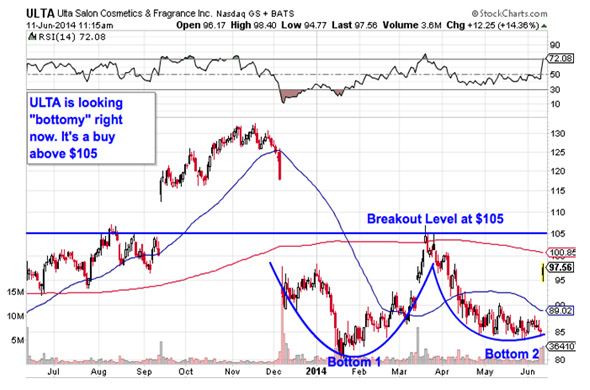
Beauty retailer Ulta Salon, Cosmetics & Fragrance (ULTA) is sitting pretty this afternoon, up more than 14.6% following the firm's positive first-quarter earnings numbers hit Wall Street. Ulta earned 77 cents per share last quarter, besting analysts' 74-cent best guess. More important, the firm provided a rosy forecast for the second quarter, estimating earnings would fall between 78 cents and 83 cents per share. Investors were hoping for an 82-cent profit next quarter.

ULTA's chart has been looking pretty unattractive for the past several months, but that's changing thanks to a double-bottom setup that started forming in shares at the start of 2014. From here, the level to watch is $105. If buyers can bid shares up above that price ceiling, we've got a buyable breakout in this beauty products retailer.

Synaptics


Nearest Resistance: N/A

Nearest Support: $70

Catalyst: Outlook Boost, Renesas Acquisition

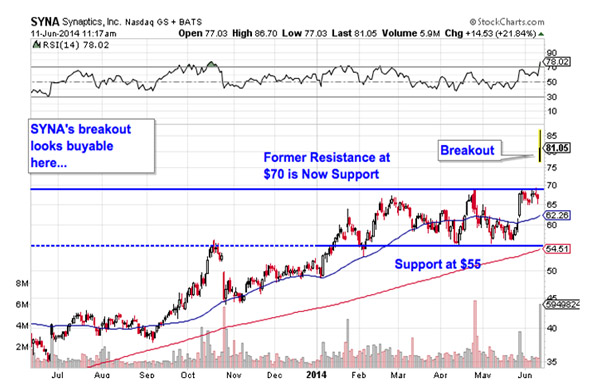
Tech name Synaptics (SYNA) is up more than 24% this afternoon, buoyed by a hike in earnings guidance as well as by news that SYNA is acquiring Japanese display driver firm Renesas SP Drivers for $475 million. The firm expects the acquisition to help drive sales to between $300 million and $310 million next quarter, a material sales boost. Today's big gap up is sending SYNA to new all-time highs this afternoon.

New highs are significant from an investor psychology standpoint because they mean that everyone who has bought shares in the last year is sitting on gains. As a result, the "back to even" mentality is less of a concern than it would be for a name with a higher proportion of shareholders sitting on losses. Today's breakout is buyable here, but it makes sense to keep a tight protective stop in place.

Delta Air Lines


Nearest Resistance: $42

Nearest Support: $36

Catalyst: Industry Correction

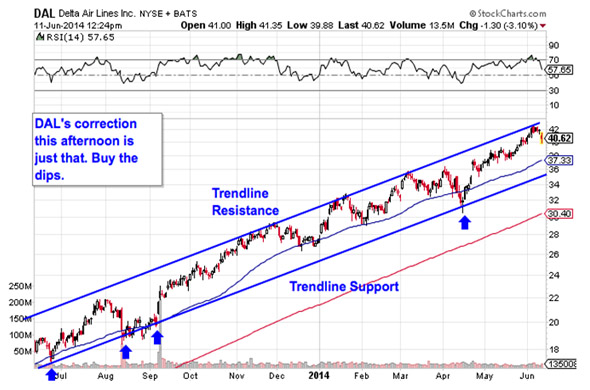
Delta Airlines (DAL) owns the undesirable distinction of being the biggest single-day loser in the S&P 500 as of this writing today. The better news is that Delta's pullback is just 3% and change. Delta is correcting as part of a larger move lower in the airline industry today, meaning that it's far from alone in giving back a few points. But that doesn't change the fact that DAL has been one of the best-performing large-cap names in 2014, and this is still very much a "buy the dips stock."

Delta continues to bounce its way higher in a textbook uptrending channel. In the context of that well-defined technical setup, today's correction isn't just immaterial -- it's expected. Look for another buying opportunity when DAL gets back down towards trendline support for a fifth time in the last year.

Achillion Pharmaceuticals


Nearest Resistance: $7.60

Nearest Support: $4.20

Catalyst: Technical Setup

Biopharma firm Achillion Pharmaceuticals (ACHN) is correcting 6.5% on big volume this afternoon, the latest high-profile day for the $706 million drug company since the acquisition of peer name Idenix Pharmaceuticals (IDIX) triggered speculation about a similar buyout deal for ACHN. Since Monday, shares are up more than 153%, which, in context, makes this afternoon's correction look a whole lot less painful.

I'd avoid buying into ACHN until it can establish some semblance of support. With the next-nearest glut of buying pressure all the way down at $4.20, there's a lot of potential loss if some unforeseen event pulls the rug out from Achillion's newfound lofty valuation.

To see these stocks in action, check out the at Most-Active Stocks portfolio on Stockpickr.


-- Written by Jonas Elmerraji in Baltimore.


RELATED LINKS:


>>5 Health Care Stocks to Trade for Gains


>>5 Rocket Stocks to Buy for June Gains


>>3 Stocks Under $10 Making Big Moves

Follow Stockpickr on Twitter and become a fan on Facebook.

At the time of publication, author had no positions in the names mentioned.

Jonas Elmerraji, CMT, is a senior market analyst at Agora Financial in Baltimore and a contributor to

TheStreet. Before that, he managed a portfolio of stocks for an investment advisory returned 15% in 2008. He has been featured in Forbes , Investor's Business Daily, and on CNBC.com. Jonas holds a degree in financial economics from UMBC and the Chartered Market Technician designation.

Follow Jonas on Twitter @JonasElmerraji


Tuesday, February 3, 2015

Sohn Conference: Buyer Beware?

As my colleagues Dimitra DeFotis and Brendan Conway blog away from the Sohn Conference, Birinyi Associates’ Chris Costelloe posts a timely reminder: most of the last year’s picks haven’t done so well.

Since the last conference, for every winning pick like Akamai Technolgies (AKAM)–which gained 19% after being picked by Blue Harbour Group’s Clifton Robbins–or Digital Realty Trust (DLR)–which rose fell 27.5% after being picked as a short by Jonathon Jacobson of Highfields Capital Management–there’s been a stinker like Chipotle Mexican Grill (CMG)–which gained 29% after Double Line’s Jeffrey Gundlach recommended shorting it–or Dex Media (DXM)–which advanced 53.7% after Hayman Capital’s Kyle Bass recommended selling. In fact, the average pick lost 3.8%, even as the S&P 500 gained 15.2%.

There’s a moral here somewhere.

For more Barron’s Sohn Conference coverage, click here, here, here and here.

Long-Term Unemployed: The Inflation Wild Card

Print Friendly

As the economy improves, understanding when the long-term unemployed will return to the workforce has become, particularly in the last few months, the central issue among economists as to when the Federal Reserve should begin looking at raising interest rates in anticipation of higher inflation.

But the problem is that economists are in deep disagreement as to when, or even if, the long-term unemployed will have a material impact on putting pressure on wages, which bolsters our thesis that America’s central bankers will again likely fail to time rates correctly.

Fed Chair Janet Yellen’s position is that wage gains continue to proceed at a historically slow pace in this recovery, with few signs of a broad-based acceleration, though she does expect the long-term unemployed to eventually rejoin the workforce.

In late April, in her first major monetary-policy framework speech to the Economic Club of New York, she said, “The long-term unemployed are likely to move back more actively into the labor force and into the job market and exert pressure on wages and prices. Clearly, we will have to watch unfolding evidence and evaluate it with an open mind.”

But even with the jobless rate near a five-year low, more than 3.7 million Americans have been unemployed six months or longer. Their share of the total ranks of the jobless exceeded 30 percent for the first time in 2009 and hasn't fallen below that level since. That gauge stood at 35.8 percent in March, down from a record 45.3 percent in April 2010, according to Bloomberg estimates.

As such, some economists disagree with Yellen’s position that the long-term unemployed should continue to be factored into inflation projections or that they will help hold down inflation pressures or provide slack. As such, they believe the short-term unemployed should be the focus of the central bank’s inflation targets an! d analysis, noting that the rate of 4.3 percent is now more or less back to its long run average – and thus argues for a less accommodative stance.  

In a paper for the Brookings Institution, former White House chief economist Alan Krueger looked at data on the long-term unemployed from 2008 to 2013 and documented the incidence of repeat joblessness. About 36 percent of those workers were in a job 15 months later, according to his analysis. But only 11 percent were in steady, full-time jobs. ​​

Krueger, in his paper, argues that the long-term unemployed are on the margins of the labor force, both because they give up on searching for a job and because employers start to discriminate against the long-term unemployed.  "We tentatively conclude that the long-term unemployed exert relatively little pressure on the economy," he said, in a Financial Times interview. As a result, the economist concludes that long-term unemployment does little to hold down wages, and, as noted, with short-term unemployment back to normal, rates should start to rise in anticipation of increased inflation.

Notwithstanding this, many argue that most measures of U.S. wage inflation are sluggish at best. In response to this argument, Yellen has said that it is premature to jump to this conclusion. She has offered that the Fed would be alert to "wage pressures that can translate into price pressures and be an early warning indicator of an impending uptick in inflation.”

But even as these economists make compelling arguments, both sides suffer from one main weakness, which is that the United States has never throughout its history had a similar period where its population suffered comparable periods of long-term joblessness. Thus, there is no baseline of comparison.

Producer Prices, Inflation Expectations on the Rise

Even as economists debate whether wage pressure is being exerted on the economy, investors have continued to react to recent inflationary signals, such as ! the rise ! in producer prices, with increased buying of inflation protection securities (See Chart A).

Chart A: Investors Continue to Buy Up Inflation-Protection Securities

 Chart A

As noted in a previous report, the prices businesses receive for their goods and services rose in March, defying a long stretch of subdued inflation across the U.S. economy, according to the Wall Street Journal. The producer price index for final demand, which measures changes in prices for everything from food and machinery to warehousing and transportation services, rose a seasonally adjusted 0.5% from February, the Labor Department reported on April 11. The index rose 0.6%, excluding the volatile categories of food and energy.

Economists surveyed by the Wall Street Journal had expected the index to rise a more modest 0.1%, and predicted a 0.2% increase excluding food and energy. The index fell 0.1% in February, unchanged from the Labor Department's initial estimate. The PPI for final demand was up 1.4% in March from a year earlier, the biggest year-over-year increase since last August.

The PPI measures the prices businesses receive from buyers such as governments, consumers and other businesses. The Labor Department overhauled the report this year to measure a much broader swath of the U.S. economy.

Given increasing expectations for inflation over the next few years are increasing as measured by demand for inflation protection securities, we recommend investors hold new portfolio holding iShares Barclay TIPS Bond (TIP), which we added to our Survive Portfolio in early March to enhance our fixed income offerings. TIP which is up 3.45% since the beginning of the year is a buy up to 118.

Sunday, February 1, 2015

Some recalled GM cars with switch problem sold…

General Motors' ignition switch recall now includes three continents, with small numbers of the cars having been sold in in Europe, Japan and South Korea.

The recalls were just announced Friday in those countries, but they are not newly discovered at-risk models.

The cars were included in the total number of vehicles, but not identified by model, in GM's Feb. 25 expansion of the original recall. The overseas models are U.S.-built exports nearly identical to the recalled North American models.

The total vehicles recalled for ignition switches that can slip out of "run," shutting off the engine and disabling the air bags, is 1.62 million worldwide. GM knows of 13 deaths in 31 front-impact crashes in which front air bags failed to deploy.

The new badges and locations identified Friday triggered incorrect speculation that GM was expanding the recall a second time.

Though only a handful — 2,591 — the exports show again, as many recent recalls have demonstrated, how the modern practice of widely sharing platforms and components to cut costs also can domino any problems across borders and oceans.

Newly identified overseas models and their numbers:

2007 Opel GT (a rebadged Saturn Sky sold in Europe): 2,3612007 Daewoo G2x (a rebadged Saturn Sky sold in South Korea): 602006 and 2007 Chevrolet HHR (a modified version sold in Japan: 170

GM spokesman Alan Adler says the cars will be fixed in those countries with new ignition switches. A schedule was not given.

The bulk of the vehicles, 1.37 million, are in the U.S. GM says 250,928 are in Canada and Mexico.

Registered owners of the recalled vehicles in this country will get official notification beginning the week of March 10 that their vehicles have been recalled because airbags might fail due to faulty ignition switches.

The letter also will repeat GM's urgent request that drivers use only the ignition key, removing it from any key chain or attachment. A heavy key chain can pull the switch out! of "run."

GM will make sure dealer parts bins are cleared to prevent any old switches being used, and believes that by early April, dealers will begin receiving the new ignition switches from supplier Delphi, which also made the original faulty switches. GM insists that it is closely monitoring the production of the replacements.

When enough new switches are on hand, owners will get a second letter from GM telling them when they can make appointments with dealers for the replacement of their ignition switches.

Owners who do not respond will get reminders about every three months for at least 18 months.

Because the cars are older and might have had multiple owners, GM will use a combination of its own records for these vehicle identification numbers (VIN), third-party lists of state motor vehicle data on the latest registered owners, and social media outreach. GM offers a site where owners can check by their car's VIN to see whether it is in the recall group.

The vehicles being recalled in the U.S. are Chevrolet Cobalts from the 2005-07 model years; 2003-07 Saturn Ions, 2006-07 Chevrolet HHRs and Pontiac Solstices; and 2007 Saturn Sky and Pontiac G5 models.